

Introduction
Single Board Computers (SBCs) using Rockchip’s RK3588S chipset are becoming increasingly popular in areas such as AIoT, robotics, edge computing, and multimedia. The Rockchip RK3588S chip features a powerful CPU, GPU, NPU, and multimedia capabilities, making it a flexible platform for both testing and final products.
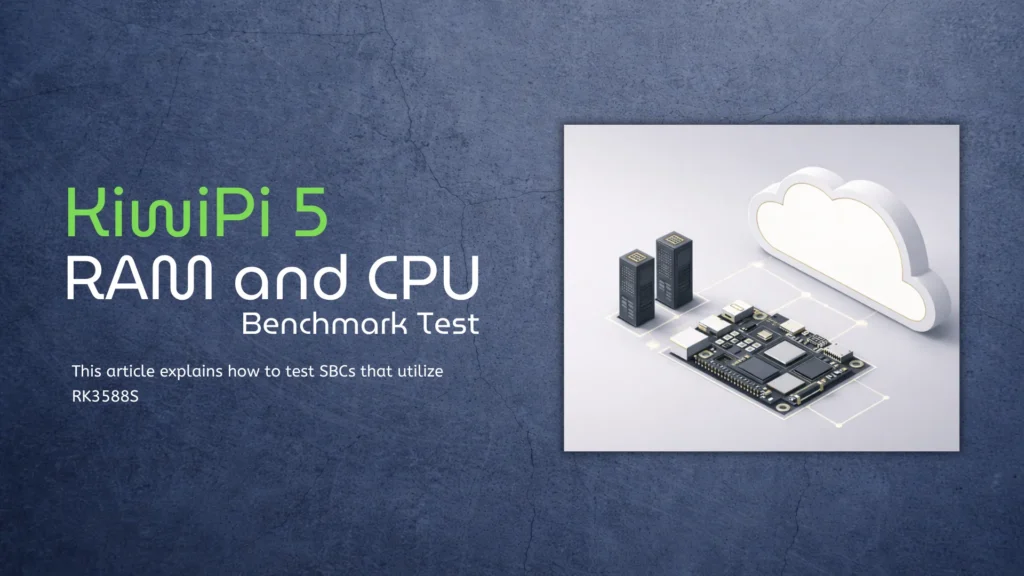
This article explains how to test SBCs that use RK3588S, with examples like Firefly boards and the Kiwi Pi 5. We will cover hardware checks and software testing. In this article, we present a quick test of the RAM and CPU on the Kiwi Pi 5 and ROC-RK3588S-PC, along with additional information below.
Why the RK3588S?
The RK3588S is an 8nm, octa-core SoC that combines:
- CPU: 4× Cortex-A76 (2.2GHz) + 4× Cortex-A55 (1.8GHz)
- GPU: ARM Mali-G610 MC4, supporting OpenGL ES 3.2, Vulkan 1.2
- NPU: 6 TOPS AI acceleration (INT4/8/16, FP16, BF16, TF32)
- VPU: 8K/60fps decoding, 8K/30fps encoding
- Memory: Up to LPDDR4X 32GB
- Connectivity: HDMI 2.1, USB 3.1, PCIe, Ethernet (with Realtek RTL8211F), Wi-Fi 6
Also, want to say that RK3588S is a cost-optimized and compact variant of the RK3588. If you want a deeper look at the chip, you can check our guide on RK3588 specs and performance explained.
Key SBC Examples
This balance of general-purpose compute, GPU rendering, and AI acceleration makes it highly attractive for SBCs. It is also widely used in edge AI devices, including dedicated AI boxes — you can explore some examples in our guide on AI Box: Top 5 Solutions of 2026.
Firefly RK3588S Boards
Firefly has released multiple SBCs based on RK3588S, such as:
- ROC-RK3588S-PC — aimed at industrial and embedded AI applications
- Station P2 — a compact RK3588S-based mini-PC
- Core-3588S-JD4 — SoM module for integration into custom designs
Kiwi Pi 5 (Our Product)
The Kiwi Pi 5 is a developer-friendly SBC built on the RK3588S:
- CPU/GPU/NPU: RK3588S, Mali-G610, 6 TOPS NPU
- Memory: 8GB LPDDR4X (options 4-32GB)
- Storage: 64GB eMMC (up to 512GB), microSD expansion
- Video: HDMI 2.1 (8K@60fps), Type-C DP 1.4 (8K@30fps), MIPI-DSI
- I/O: 2× MIPI-CSI, USB 3.1, USB 3.0, 26-pin GPIO expansion
- Networking: Wi-Fi 6, BT 5.4, Gigabit Ethernet
- OS Support: Linux 5.10/6.10, Android 12, Debian 11, Ubuntu 22.04
With a compact 56×85 mm design, Kiwi Pi 5 targets developers who need a small yet powerful AI-capable SBC.
How to Test an RK3588S SBC. RAM and CPU
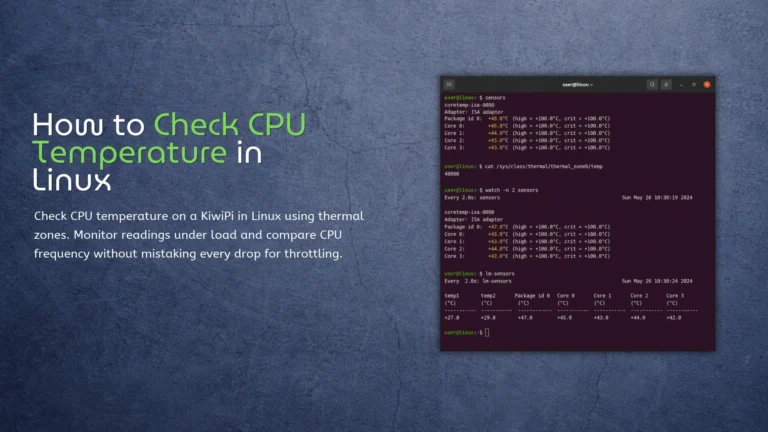
Testing should validate both hardware stability and software performance. Below are the recommended steps, and you can also check CPU temperature in Linux to monitor thermal behavior during the test.
CPU & Memory Performance
- Ram and CPU Benchmark Test Tools:
- sysbench for CPU performance
- 7-zip benchmark for compression/decompression throughput
- memtester for RAM stability
- Firefly ROC-RK3588S-PC Example: Expect ~60-70k score in Geekbench 5 multi-core.
- Kiwi Pi 5 Example: Similar results due to the same SoC, but check for cooling differences.
For example, we show how to perform a quick RAM and CPU test with Kiwi Pi 5 (Ubuntu 20.04). First step, we need to install sysbench and memtester. If you are using external storage during testing, you may also need to mount it manually. You can follow this simple guide on how to mount sda1 on Raspberry Pi.
Memtester Installation

And do a quick test:

512M — how much memory to test (not more than available free).
1 — number of loops.
Result:

So, let’s install Sysbench and run a quick test.

Result:

Performance:
- Events per second: 14,247.01
The CPU is processing ~14.2k operations/sec (integer arithmetic test). So performance is stable across runs. - Total events: 142,506 in 10s
Exactly matches the expected throughput.
Latency:
- Min latency: 0.37 ms
- Avg latency: 0.56 ms
- 95th percentile: 1.08 ms
- Max latency: 24.20 ms
Almost all operations are complete within ~1 ms, but there was a single spike up to 24.20 ms.
That could be caused by:
- background process (scheduler interrupt, I/O wait)
- thermal/power throttling kicking in briefly
- normal variation under Linux multitasking
Since the 95th percentile is only 1.08 ms, this outlier isn’t a concern.
Thread Fairness:
- Events per thread (avg): 17813
- Stddev: 8631
Workload distribution isn’t perfectly balanced. Some cores did more work than others. This is typical with sysbench on big.LITTLE CPUs (RK3588S = 4× Cortex-A76 + 4× Cortex-A55).- The Cortex-A76 (big cores) handles more tasks.
- The Cortex-A55 (little cores) are slower, so the distribution looks uneven.
- Execution time per thread: ~9.99s (almost identical across threads). Scheduler ensured all threads were active during the test.
Firefly ROC-RK3588S-PC
Typical sysbench cpu –threads=8 output reported by developers/testers:
CPU speed: ~14,000 – 14,800 events/sec
Latency (avg): 0.55 – 0.60 ms
95th percentile latency: ~1.0 ms
Interpretation:
- Very close to Kiwi Pi 5 performance (same RK3588S chip).
- Slightly higher throughput possible due to:
- better cooling (Firefly board has optional heatsink/fan kits)
- Different DDR configuration (some ROC boards use faster LPDDR4x modules).
- Thread fairness imbalance is also observed (big.LITTLE design).
Direct Comparison Table
| Feature | Kiwi Pi 5 (our test) | Firefly ROC-RK3588S-PC (example) |
|---|---|---|
| CPU Events/sec | ~14,247 | ~14,000 – 14,800 |
| Avg Latency | 0.56 ms | 0.55 – 0.60 ms |
| 95th Percentile Latency | 1.08 ms | ~1.0 ms |
| Max Latency | 24.2 ms (spike) | 10-14 ms (typical spike) |
| Threads Fairness | uneven (big.LITTLE) | uneven (big.LITTLE) |
Result:
- Both Kiwi Pi 5 and Firefly ROC-RK3588S-PC perform almost identically in CPU benchmarks (~14-15k events/sec).
- Any differences are due to cooling and RAM speed, not CPU architecture.
- Kiwi Pi 5’s compact size makes cooling more critical under sustained load, while Firefly’s larger PCB allows easier heat dissipation.
Comparing Firefly SBCs and Kiwi Pi 5
| Feature | Firefly ROC-RK3588S-PC | Kiwi Pi 5 |
|---|---|---|
| CPU/GPU | RK3588S, Mali-G610 | RK3588S, Mali-G610 |
| NPU | 6 TOPS | 6 TOPS |
| RAM | Up to 32GB | 4-32GB options |
| Storage | eMMC + NVMe | eMMC + microSD |
| Networking | Gigabit LAN, Wi-Fi 6 | Gigabit LAN, Wi-Fi 6, BT 5.4 |
| Video | 8K output | 8K output |
| Expansion | GPIO, PCIe | 26-pin GPIO |
| Form Factor | Larger board | Compact (56×85mm) |
Both share the same SoC capabilities, but Kiwi Pi 5 emphasizes compact design and developer flexibility, while Firefly boards are often targeted at industrial use cases with more expansion options.
By the way, you can also compare the Kiwi Pi 5 Pro with other SBCs.
Result?
Testing an RK3588S-based SBC involves validating power, CPU, GPU, AI, multimedia, I/O, and OS performance. Both Firefly and Kiwi Pi 5 boards showcase the potential of this SoC, but Kiwi Pi 5 stands out for developers who want a compact, Wi-Fi 6-enabled SBC with broad OS support.
Both boards show good results, but the Kiwi Pi is a small, compact board with strong RAM and CPU performance, similar to the FireFly board.
Stay updated with us:
- How to Check CPU Temperature in Linux
- CPU vs NPU in Edge AI
- Find Your IP Address on Linux: 5 Methods
- Crosh Commands for Chromebook: What Actually Works
- How to Transfer Files From Mac to Linux With SCP
- How to SSH Into a Linux Machine From Mac
- How to Change File Permissions in Linux