





Realtek RTL8211F-CG Explained
The main processor gets most of the attention on a single-board computer. It determines CPU performance, graphics capability, video decoding, and AI acceleration. But it doesn’t necessarily handle the physical Ethernet connection.
That job often belongs to a separate chip such as the Realtek RTL8211F-CG.
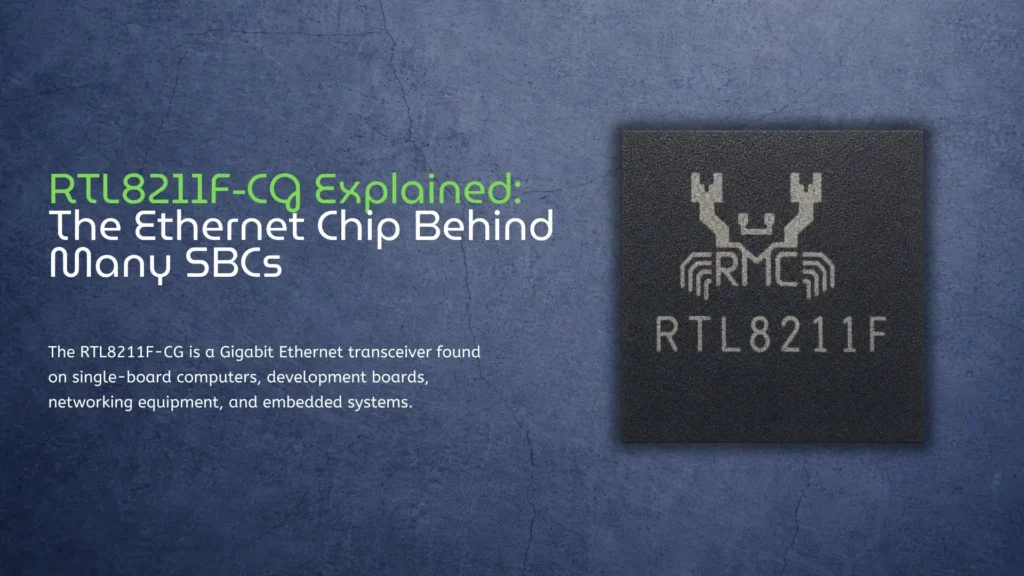
The RTL8211F-CG is a Gigabit Ethernet transceiver found on industrial single-board computers, development boards, networking equipment, and embedded systems. It isn’t responsible for processing network traffic in the same way as the main SoC. Instead, it provides the physical connection between the processor’s Ethernet controller and the RJ45 port.
This small distinction matters. A fast processor doesn’t automatically guarantee a reliable wired network connection – the Ethernet PHY and board design still need to do their part.
What Does the RTL8211F-CG Do?
The RTL8211F-CG is a Gigabit Ethernet PHY, short for physical-layer transceiver. It supports three standard Ethernet speeds:
| Ethernet standard | Maximum speed |
| 10BASE-T | 10 Mbps |
| 100BASE-TX | 100 Mbps |
| 1000BASE-T | 1 Gbps |
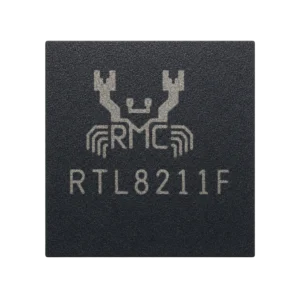
On an SBC, the main processor usually contains the Ethernet MAC controller. The RTL8211F-CG connects to that controller through an RGMII interface and converts its digital data into signals that can travel over a standard twisted-pair Ethernet cable.
The same process works in reverse when the board receives data. The PHY interprets the electrical signal arriving through the cable and passes the recovered data to the processor.
In other words, the RTL8211F-CG is the bridge between the SoC and the physical network.
Why Is It Used So Often?
There’s nothing particularly exotic about the RTL8211F-CG, and that’s part of its appeal. It provides standard Gigabit Ethernet without requiring an expensive or unusually complex networking solution.
The chip supports automatic speed negotiation, so it can establish a 10, 100, or 1000 Mbps connection depending on the connected router, switch, and cable. It also supports automatic crossover detection, reducing the need to worry about whether a straight-through or crossover cable is being used.
Realtek includes power-saving features intended to reduce unnecessary consumption when network activity is low. Wake-on-LAN support can also be useful in systems that need to remain accessible without operating at full power continuously. These aren’t spectacular features, but they make the chip practical for embedded computers expected to run unattended for long periods.
RTL8211F-CG in KiwiPi Boards
The RTL8211F-CG is used in our KiwiPi single-board computers, including the KiwiPi 5. On this board, it provides the physical interface for the 1000 Mbps RJ45 Ethernet connection.
KiwiPi 5 is based on the RK3588S, while other boards in the family use the full RK3588. Our article covering the main RK3588 and RK3588S differences explains how these processors differ in PCIe connectivity, display support, and other interfaces.
For KiwiPi 5, the combination is straightforward: the RK3588S handles the operating system, applications, media processing, and AI workloads, while the RTL8211F-CG handles the electrical side of the Gigabit Ethernet connection. If you want a broader look at the processor itself, our complete RK3588 performance guide covers its CPU, GPU, NPU, and multimedia capabilities.
A dedicated PHY also gives board designers more control over the Ethernet layout. Signal routing, clock configuration, power delivery, transformer selection, and PCB quality can all affect the final connection. Two boards using the same Realtek chip may therefore behave differently if the surrounding hardware has been designed poorly.
Does It Guarantee Full Gigabit Speed?
Not by itself.
The RTL8211F-CG supports Gigabit Ethernet, but actual transfer speed depends on the entire system. Processor load, drivers, memory performance, storage speed, operating-system configuration, and network equipment can all create bottlenecks.
A practical wired transfer rate will also be lower than the theoretical 1 Gbps link speed because Ethernet, IP, TCP, and file-transfer protocols introduce overhead. Slow microSD storage can become the limiting factor before the network interface does, especially when moving many small files.
This is why the Ethernet controller should be considered as part of the complete board rather than evaluated in isolation. The same principle applies when comparing KiwiPi with other ARM computers, as shown in our Raspberry Pi 5 comparison.
What Does CG Mean?
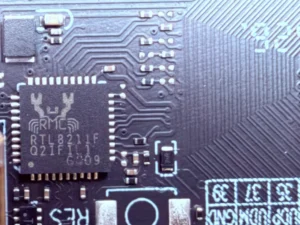
The full marking identifies the specific package and commercial version of the chip. Realtek also offers related variants, including industrial-temperature versions and models with different interface options.
Additional numbers printed below or beside RTL8211F are usually manufacturing, lot, date, or traceability codes. They don’t necessarily indicate a different Ethernet controller. When identifying the component, the RTL8211F-CG part of the marking is what matters.
The Bottom Line
The RTL8211F-CG won’t make an SBC look more impressive on a specification sheet. It doesn’t add CPU cores, AI performance, or faster graphics.
What it does provide is something less exciting but equally necessary: a proven physical interface for reliable Gigabit Ethernet. That’s why it appears on so many embedded boards – and why we use it in KiwiPi systems such as the single-board computer KiwiPi 5.
Links:
- Realtek RTL8211F CG Datasheet
- Realtek Product Page (Official)