





Not every processor needs to be a flagship, while hardware announcements often focus on higher benchmark scores, faster CPU cores, and increasingly powerful AI accelerators, many successful embedded processors are built around a simpler idea: deliver enough performance at the right price and power level, as our Allwinner vs Rockchip comparison shows.
The Rockchip RK3566 is a good example; since its introduction, it has appeared in single-board computers, retro gaming handhelds, e-readers, industrial controllers, smart displays, and many other embedded Linux devices. It rarely attracts the same attention as Rockchip’s higher-end chips, but it has become one of the company’s most widely used platforms.
Its specifications are modest by current standards. The chip uses four Cortex-A55 CPU cores, Mali-G52 graphics, and an integrated 1 TOPS NPU. It cannot compete with the Rockchip RK3576 or Rockchip RK3588 in demanding AI, desktop, or multimedia workloads, but that was never really the point. The newer, though less powerful, Rockchip RK3562 Specs NPU operates with a similar approach, focusing on particular embedded applications with a 1 TOPS NPU and Cortex-A53 cores.
RK3566 became popular because it offers a practical balance of cost and power efficiency. For many embedded products, that matters more than peak performance. A processor does not need to be exciting if it is affordable, stable, and capable of doing the job reliably.
The chip also represents an important stage in Rockchip’s development. The company moved from low-cost processors for media players and Android tablets toward Linux SBCs, industrial systems, and embedded computing platforms. That broader transition is covered in Rockchip’s processor evolution.
Why RK3566 Became So Popular
On paper, RK3566 doesn’t seem particularly remarkable.
When Rockchip introduced the processor around 2020, the embedded market already offered plenty of quad-core Arm processors. Many manufacturers were beginning to talk about AI acceleration, while higher-end chips with Cortex-A72 and Cortex-A76 cores were becoming increasingly common.
Instead of competing directly with those processors, Rockchip focused on something different: building a well-balanced platform that could satisfy the needs of several product categories at once.
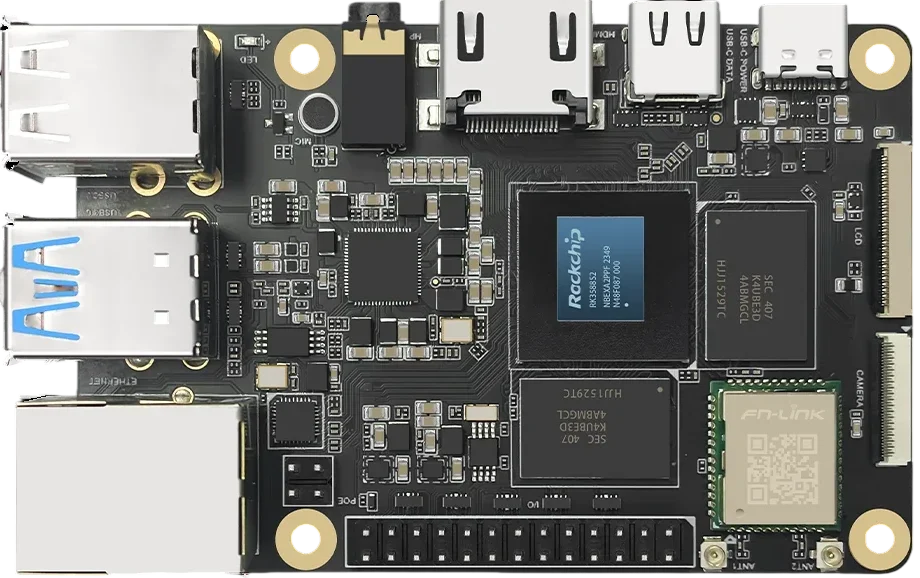
RK3566 combines four Cortex-A55 cores with modern multimedia hardware, PCIe support, Gigabit Ethernet, USB 3.0, and a modest AI engine. None of those features stands out individually, but together they create a processor that’s flexible enough for everything from educational SBCs to industrial control systems.
Developing hardware around a single processor family reduces engineering effort, simplifies software maintenance, and shortens product development cycles. RK3566 became attractive not because it was the fastest option available, but because it consistently delivered reliable performance across a wide range of embedded applications. Even today, that formula still works.
RK3566 Specifications
Looking only at specifications rarely tells the whole story, but they do explain why RK3566 has remained relevant for so many years.
CPU
RK3566 uses a quad-core 64-bit Arm processor based entirely on Cortex-A55 cores.
| Specification | Details |
| CPU Architecture | 64-bit Arm |
| CPU Cores | 4 × Cortex-A55 |
| Manufacturing Process | 22 nm |
Unlike processors that mix performance and efficiency cores, RK3566 uses four identical Cortex-A55 cores. That simplifies scheduling while keeping power consumption low, making the chip particularly suitable for always-on embedded systems.
The CPU isn’t designed for workstation-class computing, but it’s more than capable of running modern Linux distributions, lightweight desktop environments, media applications, and industrial software.
GPU
Graphics are handled by the Arm Mali-G52 2EE GPU.
While considerably less powerful than the Mali-G610 found in RK3588, it comfortably supports the kinds of workloads RK3566 typically encounters:
- Linux desktop environments
- digital signage
- multimedia playback
- lightweight 3D graphics
- industrial HMIs
Support for OpenGL ES, Vulkan, and OpenCL also gives developers access to modern graphics APIs without requiring dedicated graphics hardware.
NPU
Unlike many entry-level embedded processors released around the same time, RK3566 includes a dedicated Neural Processing Unit.
The integrated NPU delivers up to 1 TOPS of AI performance.
That may seem modest compared to newer processors offering 6 TOPS or more, but it’s sufficient for lightweight inference workloads such as:
- image classification
- facial recognition
- OCR
- object detection
- simple computer vision
For many embedded devices, these workloads don’t require massive AI accelerators. A modest NPU can significantly reduce CPU utilization while improving response times.
Memory
RK3566 supports several widely available memory standards, making it easier for manufacturers to optimize products for either performance or cost.
Supported memory includes:
- LPDDR4
- LPDDR4X
- DDR4
This flexibility has helped the processor appear in products ranging from affordable developer boards to commercial industrial hardware.
Multimedia
Rockchip has traditionally placed considerable emphasis on multimedia capabilities, and RK3566 follows that trend.
Its hardware video engine supports:
- 4K video decoding
- 1080p encoding
- H.264
- H.265 (HEVC)
- VP9
These capabilities make RK3566 particularly well suited for media players, smart displays, digital signage, and streaming applications.
Connectivity
One reason RK3566 became popular with hardware manufacturers is its broad selection of integrated interfaces.
Typical connectivity options include:
- PCIe
- USB 3.0
- USB 2.0
- Gigabit Ethernet
- SATA
- HDMI
- MIPI CSI
- MIPI DSI
- UART
- SPI
- I²C
- GPIO
This extensive I/O reduces the need for additional bridge chips and gives designers considerable flexibility when building embedded products.
The Story Behind RK3566
RK3566 arrived at an interesting time for both Rockchip and the broader embedded computing market.
By 2020, the company already had a strong presence in Android TV boxes and consumer electronics, but demand was shifting. Manufacturers were looking for processors that could run Linux reliably, support modern multimedia features, and remain affordable enough for products with long development cycles.
That demand wasn’t coming from flagship devices. It came from companies building industrial controllers, educational computers, digital signage players, and compact single-board computers.
RK3566 was designed with those requirements in mind.
Rather than chasing raw CPU performance, Rockchip focused on building a processor that offered a practical feature set. Four Cortex-A55 cores provided sufficient computing power for everyday embedded workloads, while PCIe, Gigabit Ethernet, USB 3.0, and hardware 4K video decoding gave hardware designers the interfaces they actually needed.
It was also one of Rockchip’s first mainstream processors to include a dedicated NPU. While the 1 TOPS accelerator is modest compared to newer chips, it allowed lightweight computer vision and AI inference without relying entirely on the CPU.
Looking back, that decision seems almost inevitable. Today, nearly every new Rockchip processor includes dedicated AI hardware, but RK3566 was among the first affordable platforms where that capability became widely available.
Linux Came at the Right Time
Another reason RK3566 gained traction had little to do with hardware specifications.
Linux support was improving rapidly.
The processor became popular among SBC manufacturers just as distributions such as Debian, Ubuntu, Armbian, and Buildroot were becoming more mature on Arm platforms. Developers no longer needed to rely exclusively on customized Android builds to create commercial products.
Instead, they could build systems around familiar Linux environments while benefiting from Rockchip’s multimedia acceleration and growing upstream kernel support.
That combination helped RK3566 establish itself as one of the most approachable Rockchip processors for developers entering the ARM ecosystem.
Where RK3566 Is Used
Perhaps the best measure of a processor isn’t its benchmark score but the variety of products built around it.
RK3566 has appeared in far more commercial devices than many newer processors, largely because it offers enough performance without significantly increasing hardware costs.
Single-Board Computers
RK3566 became particularly popular in the SBC community, which makes single-board computers so important now.
Boards such as the Orange Pi 3B, Radxa ROCK 3C, Radxa ZERO 3W, and Quartz64 all use the processor to provide affordable Linux development platforms with features that would have been difficult to find in similarly priced boards just a few years earlier. These systems combine Gigabit Ethernet, PCIe expansion, USB 3.0, and hardware 4K video decoding while remaining relatively inexpensive.
For developers building media servers, home automation systems, lightweight desktop environments, or embedded applications, RK3566 quickly became an attractive alternative to older Raspberry Pi generations.
Retro Gaming Handhelds
One of the more unexpected success stories for RK3566 has been retro gaming.
Manufacturers, including Anbernic and Powkiddy, adopted the processor across multiple handheld consoles, where it proved capable of emulating systems ranging from the original PlayStation to Dreamcast, PSP, Nintendo 64, and many arcade platforms.
Devices such as the RG353 series, Powkiddy RGB30, and Powkiddy X55 continue to receive software updates through projects like ROCKNIX, demonstrating that the platform remains actively supported several years after launch.
By the way, if you’re interested in playing retro games, we have an article about installing a Linux PS1 emulator on KiwiPi 5.
E-Readers and Smart Displays
RK3566 has also found its way into products where responsiveness matters more than raw computing power.
Several Android-based e-readers and digital reading devices use the processor because it comfortably handles modern user interfaces, wireless connectivity, multimedia decoding, and moderate multitasking without excessive energy consumption.
The same characteristics make it suitable for interactive kiosks, conference room displays, information terminals, and digital signage systems that often remain powered on around the clock.
Industrial Computing
Industrial products typically remain in service much longer than consumer electronics.
For that reason, manufacturers often prefer mature platforms over the latest hardware.
RK3566 fits that philosophy well. Its combination of stable Linux support, broad I/O connectivity, PCIe expansion, Gigabit Ethernet, and moderate power consumption makes it a practical choice for industrial gateways, control panels, edge controllers, and factory automation systems.
Many of these applications don’t require flagship CPU performance. They require predictable behavior, long-term software support, and dependable multimedia capabilities—all areas where RK3566 performs remarkably well.
RK3566 vs RK3576 vs RK3588
As Rockchip’s product lineup has grown, choosing the right processor has become less straightforward. RK3566 remains an excellent entry-level platform, but newer processors target different workloads rather than simply replacing it.
| Feature | RK3566 | RK3576 | RK3588 |
| CPU | 4× Cortex-A55 | 4× Cortex-A72 + 4× Cortex-A53 | 4× Cortex-A76 + 4× Cortex-A55 |
| GPU | Mali-G52 2EE | Mali-G52 MC3 | Mali-G610 MP4 |
| NPU | 1 TOPS | 6 TOPS | 6 TOPS |
| Video Decode | 4K | 4K120 | 8K |
| Typical Use | SBCs, Media Players | Edge AI | High-End AI & Multimedia |
RK3566 is still an excellent choice for Linux SBCs, media players, industrial controllers, and lightweight desktop systems. However, projects involving computer vision, robotics, or more demanding AI workloads benefit significantly from the newer RK3576.
Our Rockchip RK3576 Guide takes a closer look at what that processor adds beyond the RK3566 generation.
If maximum CPU and GPU performance is your priority, RK3588 remains Rockchip’s flagship platform. RK3588 Simply Explained: Specs & Speed covers its architecture and explains why it’s better suited for AI servers, advanced multimedia systems, and high-performance embedded applications.
Advantages and Limitations
Like any processor, RK3566 makes a few compromises—but they’re generally sensible ones.
Advantages
- Affordable and widely available.
- Excellent Linux support.
- Low power consumption.
- Hardware 4K video decoding.
- Broad I/O with PCIe, Gigabit Ethernet, and USB 3.0.
- Used in a large number of mature commercial products.
Limitations
- Cortex-A55 cores are beginning to show their age.
- The 1 TOPS NPU is suitable only for lightweight AI workloads.
- Graphics performance is adequate rather than exceptional.
For many embedded products, those limitations simply aren’t deal breakers. If your application doesn’t require desktop-class performance, RK3566 still offers one of the best price-to-performance ratios in Rockchip’s lineup.
Should You Choose RK3566?
The answer depends on what you’re building.
If you need an affordable processor for a Linux SBC, media player, industrial controller, or embedded gateway, RK3566 remains an easy recommendation. It has a mature software ecosystem, stable hardware, and enough performance for most everyday embedded workloads.
On the other hand, if your project relies heavily on AI inference or requires substantially more CPU performance, RK3576 or RK3588 will be a better long-term investment.
RK3566 may no longer be Rockchip’s newest processor, but it has proven something more important: balanced hardware often has a longer lifespan than chasing the latest specifications. For many developers, that’s exactly why it continues to be relevant.
Frequently Asked Questions
Is RK3566 still a good processor in 2026?
Yes. While newer Rockchip processors offer better AI and CPU performance, RK3566 remains an excellent choice for Linux SBCs, media players, industrial systems, and embedded devices where low power consumption and affordability are more important than maximum performance.
Does RK3566 support Linux?
Yes. RK3566 supports several Linux distributions, including Debian, Ubuntu, Armbian, Buildroot, and Yocto. It also benefits from a mature software ecosystem thanks to years of community development.
How powerful is the RK3566 NPU?
The integrated NPU delivers up to 1 TOPS of AI performance. It’s suitable for lightweight AI tasks such as image classification, OCR, and simple object detection, but it’s not intended for large neural networks or advanced edge AI workloads.
Can RK3566 decode 4K video?
Yes. RK3566 includes dedicated hardware video acceleration with support for 4K decoding, making it a popular choice for media players, digital signage, and multimedia applications.
What is the difference between RK3566 and RK3576?
RK3576 offers a significantly faster CPU, a much more capable 6 TOPS NPU, improved multimedia hardware, and newer memory support. RK3566 remains the better option for cost-sensitive projects, while RK3576 is designed for modern edge AI applications.
Is RK3566 suitable for single-board computers?
Absolutely. Many popular SBCs use RK3566 thanks to its balance of performance, power efficiency, and Linux compatibility. It remains one of Rockchip’s most successful processors in this category.
Is RK3566 better than Raspberry Pi?
That depends on the application. Many RK3566 boards offer features such as PCIe, Gigabit Ethernet, or eMMC storage at competitive prices. Software compatibility, however, is generally broader on Raspberry Pi because of its larger ecosystem.
Which applications are best suited for RK3566?
RK3566 performs well in:
- Linux single-board computers
- industrial controllers
- media players
- digital signage
- smart displays
- retro gaming handhelds
- embedded gateways