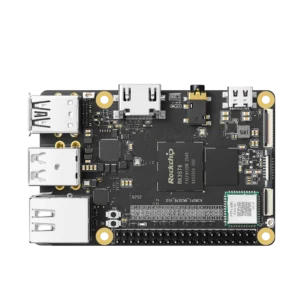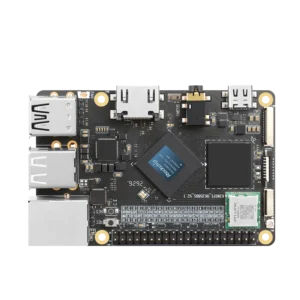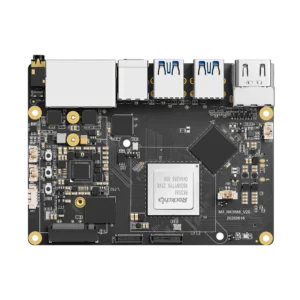


There was a time when Rockchip’s product lineup was relatively easy to understand. If you needed an entry-level processor, there was the Rockchip RK3566. For more demanding industrial systems and higher-end single-board computers, the RK3568 became the obvious choice. And if performance mattered above everything else, the RK3588 quickly established itself as the flagship.
RK3576 changes that picture a bit.
At first glance, it doesn’t look like a replacement for any existing Rockchip processor. It isn’t faster than the RK3588, and it isn’t intended to be. Instead, it fills a gap that has become increasingly important as edge AI applications move from the cloud to local devices. Many embedded systems don’t need the sheer computing power of an RK3588, but they still require modern multimedia capabilities, an integrated neural processor, and enough CPU performance to run multiple workloads simultaneously.
For a detailed comparison, see our RK3576 and RK3588 comparison guide.
That’s exactly where RK3576 fits.
It combines four Cortex-A72 performance cores with four Cortex-A53 efficiency cores, integrates a 6 TOPS NPU for AI inference, supports modern Linux distributions, and includes hardware capable of decoding 8K video. More importantly, it does all of this while maintaining a considerably lower power envelope than many flagship processors aimed at desktop-class workloads.
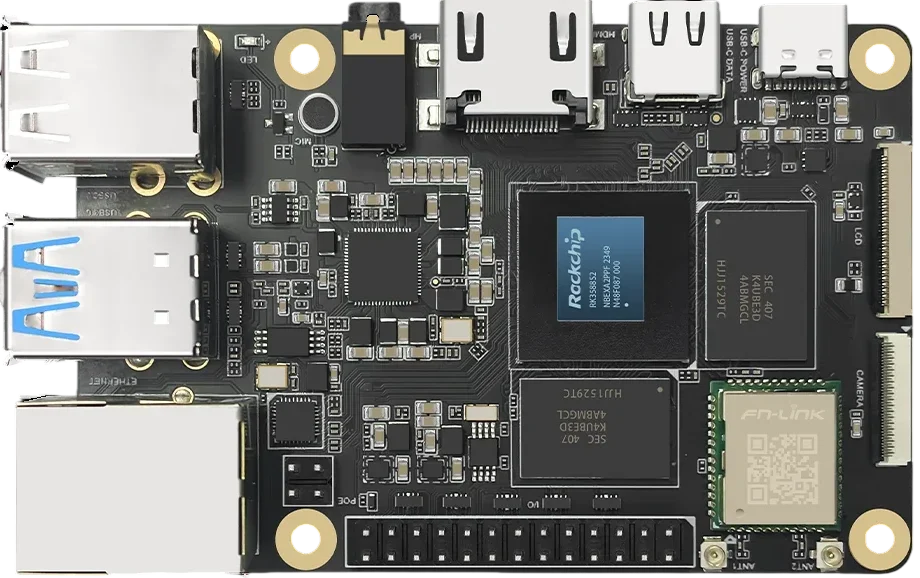
This makes RK3576 an interesting option for industrial computers, smart transportation, robotics, AI cameras, digital signage, and the growing number of edge devices expected to process data locally instead of sending everything to the cloud.
The processor also represents another step in Rockchip’s long evolution as a semiconductor company. A decade ago, the company was best known for building chips for MP3 players and Android tablets. Today, its processors are increasingly found in AI systems, industrial automation, and embedded Linux platforms.
That transition is covered in more detail in Rockchip: From MP3 Players to Modern SBCs, which explains how Rockchip gradually shifted from consumer electronics toward professional embedded computing.
Why Rockchip Built RK3576
If you compare product launches over the past few years, a clear trend starts to emerge.
Industrial hardware is becoming more demanding.
A factory inspection camera that once captured images now performs object detection in real time. Digital signage no longer displays static content but renders interactive interfaces and AI-generated recommendations. Public transportation terminals process payments, display live information, and often run computer vision algorithms at the same time.
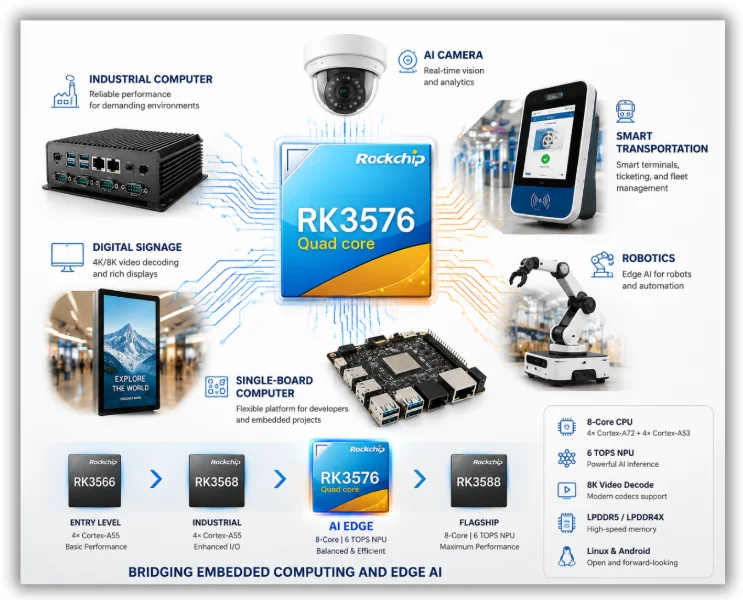
These workloads don’t necessarily require a flagship processor with desktop-level performance. What they need is balance.
That balance is what RK3576 appears to target.
Instead of chasing benchmark numbers, Rockchip focused on combining several capabilities that modern embedded systems increasingly expect as standard:
- an eight-core CPU using Arm’s proven big.LITTLE architecture;
- a dedicated 6 TOPS neural processing unit;
- modern multimedia hardware with 8K decoding support;
- extensive industrial interfaces;
- compatibility with Linux and Android.
None of those features is revolutionary on its own. Together, however, they create a processor that feels much more modern than the RK3568 generation without reaching the complexity or the cost typically associated with flagship SoCs.
Another factor is AI.
Only a few years ago, running neural networks locally was considered a niche requirement. Today it’s becoming common across surveillance, robotics, industrial automation, retail, and transportation. Moving inference to the edge reduces latency, lowers bandwidth requirements, and avoids sending sensitive data to external servers.
That explains why nearly every new Rockchip processor now includes dedicated AI hardware rather than relying solely on CPU or GPU acceleration.
RK3576 isn’t trying to compete with desktop AI accelerators. Instead, it provides enough performance for practical edge inference while keeping power consumption appropriate for embedded systems that may run continuously for years.
RK3576 Specifications
On paper, RK3576 doesn’t introduce an entirely new CPU architecture. Instead, it refines a combination that has already proven reliable across embedded platforms while pairing it with newer AI and multimedia hardware.
CPU
The processor uses an eight-core Arm CPU built around the familiar big.LITTLE design:
| Specification | Details |
| CPU Architecture | 64-bit Arm |
| Performance Cores | 4 × Cortex-A72 |
| Efficiency Cores | 4 × Cortex-A53 |
| Manufacturing Process | 8 nm |
The Cortex-A72 cores handle demanding workloads such as AI preprocessing, industrial software, and multitasking, while the Cortex-A53 cluster takes care of background services and lower-priority processes.
It’s not the newest Arm CPU design available today, but Cortex-A72 remains a practical choice for embedded Linux systems where stability and software compatibility often matter more than adopting the latest architecture.
GPU
Graphics are handled by the Arm Mali-G52 MC3 GPU.
This isn’t a gaming processor, nor is it trying to be one. Instead, the GPU is designed for modern embedded graphics workloads:
- hardware-accelerated user interfaces;
- digital signage;
- industrial HMIs;
- multimedia playback;
- lightweight 3D rendering.
Support for OpenGL ES, Vulkan, and OpenCL also gives developers flexibility when building graphical applications across Linux and Android.
NPU
The biggest upgrade compared with older Rockchip processors is the integrated neural processing unit.
RK3576 delivers up to 6 TOPS of AI computing performance, allowing inference workloads to run directly on the device instead of relying on cloud services.
Supported frameworks include TensorFlow, TensorFlow Lite, ONNX, PyTorch, and Caffe, making it easier to deploy existing machine learning models without extensive conversion.
In practical terms, that enables applications such as:
- object detection;
- facial recognition;
- OCR;
- defect inspection;
- speech recognition;
- image classification.
For many embedded products, the NPU is arguably more important than raw CPU performance. AI workloads that would otherwise occupy multiple CPU cores can instead run on dedicated hardware, improving both responsiveness and power efficiency.
The Story Behind RK3576
Unlike flagship processors that tend to grab headlines, RK3576 arrived with relatively little fanfare.
Rockchip first revealed the processor on its product roadmap in late 2023 as a new member of the RK35xx family. At the time, the company’s lineup already covered two very different segments. The RK3566 and RK3568 had become well-established choices for embedded Linux systems, industrial controllers, and entry-level SBCs, while the RK3588 targeted significantly more demanding workloads with newer Cortex-A76 CPU cores, a more powerful GPU, and extensive multimedia capabilities.
That left an interesting gap.
Many embedded products were beginning to require dedicated AI acceleration and modern multimedia features, but they didn’t necessarily need – or couldn’t justify – the additional cost, complexity, or thermal requirements of a flagship SoC.
RK3576 appears to have been designed for exactly that space.
Rather than introducing an entirely new CPU architecture, Rockchip combined a mature Cortex-A72/Cortex-A53 configuration with a much newer multimedia subsystem, LPDDR5 support, updated display interfaces, and the same 6 TOPS NPU found in some of the company’s higher-end AI platforms.
It’s a fairly pragmatic design.
The CPU isn’t the newest available from Arm, but embedded hardware often values stability, long-term software support, and predictable thermals over chasing benchmark numbers. That philosophy is visible throughout RK3576.
Where RK3576 Is Being Used
One of the easiest ways to judge a processor isn’t by reading its specification sheet, but by looking at the products manufacturers actually build around it.
Although RK3576 is still relatively new compared to processors like RK3568 or RK3588, it’s already appearing across several categories of embedded hardware.
Single-Board Computers
One of the earliest commercial SBCs based on RK3576 is the ArmSoM Sige5.
Rather than positioning itself as a desktop replacement, the board targets developers building AI edge devices, industrial controllers, robotics projects, and multimedia systems. It exposes many of RK3576’s strengths, including dual Gigabit Ethernet, PCIe expansion, modern Linux support, and the integrated 6 TOPS NPU.
The board also illustrates where Rockchip seems to be heading as a company. Instead of focusing exclusively on Android TV boxes – as it often did a decade ago – the ecosystem increasingly revolves around Linux-first embedded platforms.
Open Hardware Projects
Another interesting example comes from Flipper One.
Unlike the original Flipper Zero, which is built around microcontrollers, Flipper One is designed as a portable Linux computer powered by RK3576. The developers have been unusually transparent about why they selected this processor.
According to the project’s documentation, the decision wasn’t based solely on performance. They cited several factors, including relatively low power consumption, modern peripheral support, Vulkan graphics, integrated AI acceleration, and ongoing work to improve upstream Linux compatibility.
That last point is particularly interesting.
Instead of relying indefinitely on vendor-specific software packages, the Flipper team has been actively contributing to mainline Linux support for RK3576 together with Collabora. For developers who care about long-term kernel support, that’s arguably just as important as another few hundred points in a benchmark.
Industrial and Commercial Systems
Beyond developer boards, RK3576 is increasingly aimed at products that users rarely think about directly.
Industrial HMIs, AI-enabled inspection systems, smart kiosks, digital signage players, medical terminals, and edge gateways all benefit from a processor that combines moderate CPU performance with dedicated AI hardware.
These systems often remain in service for five to ten years. Reliability, software support, and interface availability tend to matter far more than absolute peak performance.
RK3576 seems to reflect those priorities remarkably well.
Real-World Applications
Looking at the specification sheet, it’s tempting to think of RK3576 as simply another Arm processor.
In practice, the processor makes more sense when viewed through the products it’s designed to power.
Edge AI
The integrated 6 TOPS NPU allows AI inference to run locally without depending on cloud services.
That’s useful for applications such as:
- object detection;
- quality inspection on manufacturing lines;
- facial recognition;
- OCR;
- traffic analysis;
- smart retail systems.
Running these workloads on-device reduces latency while avoiding the privacy concerns associated with constantly transmitting video streams to remote servers.
Transportation Systems
Public transportation is another area where processors like RK3576 are becoming increasingly relevant.
Modern ticketing terminals combine multiple workloads at once: touchscreen interfaces, QR code recognition, NFC readers, cameras, network connectivity, and payment processing.
If you’re interested in how this hardware has evolved, Suica Readers: The Hidden Hardware explores the technology behind Japan’s famous contactless fare collection systems and the embedded platforms that make them possible.
Industrial Automation
Factories continue moving more intelligence toward the edge.
Instead of sending every image or sensor reading to a central server, many systems now perform inference directly inside cameras or industrial controllers.
RK3576 provides enough CPU performance to manage operating system tasks while allowing the dedicated NPU to process AI workloads independently, helping reduce overall system latency.
RK3576 vs Other Rockchip Processors
One of the questions that comes up most often is whether RK3576 replaces the RK3568 or whether it’s simply a less expensive RK3588.
The answer is somewhere in between.
RK3576 isn’t intended to replace Rockchip’s flagship platform. If your application involves heavy virtualization, multiple 8K displays, large AI models, or desktop-class Linux workloads, the RK3588 remains the better option.
At the same time, RK3576 is a noticeable step forward from the RK3566 and RK3568 families. It brings a much stronger AI engine, a faster GPU, newer memory support, and a multimedia subsystem that’s designed for today’s embedded workloads rather than those of five years ago.
The easiest way to think about the lineup is this:
| Feature | RK3566 | RK3568 | RK3576 | RK3588 |
| CPU | 4× Cortex-A55 | 4× Cortex-A55 | 4× Cortex-A72 + 4× Cortex-A53 | 4× Cortex-A76 + 4× Cortex-A55 |
| CPU Cores | 4 | 4 | 8 | 8 |
| Process | 22 nm | 22 nm | 8 nm | 8 nm |
| GPU | Mali-G52 MC1 | Mali-G52 MC2 | Mali-G52 MC3 | Mali-G610 MP4 |
| NPU | – | Up to 1 TOPS | 6 TOPS | 6 TOPS |
| Memory | LPDDR4/DDR4 | LPDDR4/DDR4 | LPDDR4/LPDDR4X/LPDDR5 | LPDDR4X/LPDDR5 |
| Video Decode | 4K | 4K | 4K120 / modern codecs | Up to 8K |
| Best For | Entry-level SBCs | Industrial controllers | AI edge devices | High-end AI & multimedia |
Looking purely at CPU performance, the RK3588 still has a comfortable lead thanks to its newer Cortex-A76 cores. GPU performance also favors the flagship chip, particularly for demanding graphics workloads or advanced user interfaces.
Where RK3576 becomes interesting is value.
Many embedded products simply don’t need the fastest processor available. They need enough CPU performance, a capable AI accelerator, modern multimedia support, and reasonable power consumption. In that context, RK3576 often makes more sense than jumping directly to the flagship platform.
If you’re deciding between Rockchip’s high-end processors, our RK3588 vs RK3588S comparison explains the architectural differences between those two chips and when each one is the better choice.
Advantages and Limitations
No processor is perfect, and RK3576 is no exception.
After looking at both the specifications and the products already using the chip, several strengths stand out.
What RK3576 Does Well
- Excellent balance between CPU performance and power efficiency.
- Integrated 6 TOPS NPU suitable for practical edge AI workloads.
- Modern multimedia engine with support for current codecs.
- Broad Linux ecosystem with growing upstream kernel support.
- Extensive I/O for industrial and embedded hardware.
- Lower cost than flagship Rockchip platforms while retaining many of their most useful features.
Perhaps its biggest advantage is balance.
Nothing about RK3576 looks extreme on paper. Instead, nearly every subsystem feels appropriately matched to the others, which is often exactly what embedded developers want.
Where RK3576 Falls Short
That doesn’t mean it’s the right processor for every project.
The Cortex-A72 cores remain capable, but they’re now two architectural generations behind the Cortex-A76 used in RK3588. Applications that spend most of their time on raw CPU computation will naturally benefit from the newer architecture.
Graphics performance is another compromise.
The Mali-G52 MC3 is perfectly adequate for industrial interfaces, multimedia players, and lightweight 3D workloads, but it isn’t intended for demanding graphics applications or advanced desktop environments.
Finally, while Linux support continues to improve rapidly, RK3576 is still a younger platform than RK3568. Developers working with highly customized kernels may occasionally encounter software that’s still catching up with newer hardware revisions. Fortunately, upstream work has been progressing steadily, which should improve long-term support over time.
Should You Choose RK3576?
That depends more on your project than on benchmark numbers.
If you’re building an industrial controller, an AI camera, a smart kiosk, a robotics platform, or an edge computing device, RK3576 strikes a compelling balance between performance, features, and efficiency.
It’s powerful enough to run modern Linux distributions comfortably, capable enough to execute AI inference locally, and flexible enough to support the interfaces that embedded systems typically require.
On the other hand, if your application demands maximum CPU performance, multiple high-resolution displays, virtualization, or intensive multimedia processing, the RK3588 family remains the stronger choice.
In many ways, RK3576 feels like the processor that bridges two generations of Rockchip hardware. It offers considerably more capability than the RK3568 without trying to compete directly with the flagship lineup.
For many developers, that’s exactly what makes it interesting.
Frequently Asked Questions
Is RK3576 faster than RK3568?
Yes. RK3576 offers a significantly more capable CPU configuration, a stronger GPU, and a 6 TOPS NPU, making it much better suited for AI inference, multimedia, and multitasking workloads.
Is RK3576 better than RK3588?
Not necessarily. RK3588 remains Rockchip’s flagship processor and delivers higher CPU and GPU performance. RK3576 is designed as a more balanced and cost-effective solution for embedded AI applications.
Does RK3576 support Linux?
Yes. RK3576 supports Linux distributions including Debian, Ubuntu, Buildroot, and Yocto, with upstream kernel support continuing to improve.
What AI performance does RK3576 offer?
The integrated NPU delivers up to 6 TOPS, enabling on-device AI inference for computer vision, OCR, object detection, speech recognition, and other edge AI applications.
Is RK3576 suitable for single-board computers?
Absolutely. Several development boards already use RK3576, and the processor is well suited for Linux SBCs focused on AI, robotics, industrial automation, and multimedia.
Which memory types does RK3576 support?
RK3576 supports LPDDR4, LPDDR4X, LPDDR5, and DDR4 memory, giving hardware designers flexibility depending on performance and cost requirements.
Can RK3576 decode 8K video?
Yes. The multimedia engine supports hardware decoding for high-resolution video streams and modern codecs, making it suitable for digital signage and media applications.
Is RK3576 a good choice for edge AI?
Yes. In fact, that’s one of its primary strengths. The combination of an eight-core CPU, integrated 6 TOPS NPU, modern multimedia hardware, and relatively efficient power consumption makes it a strong platform for edge AI deployments.