





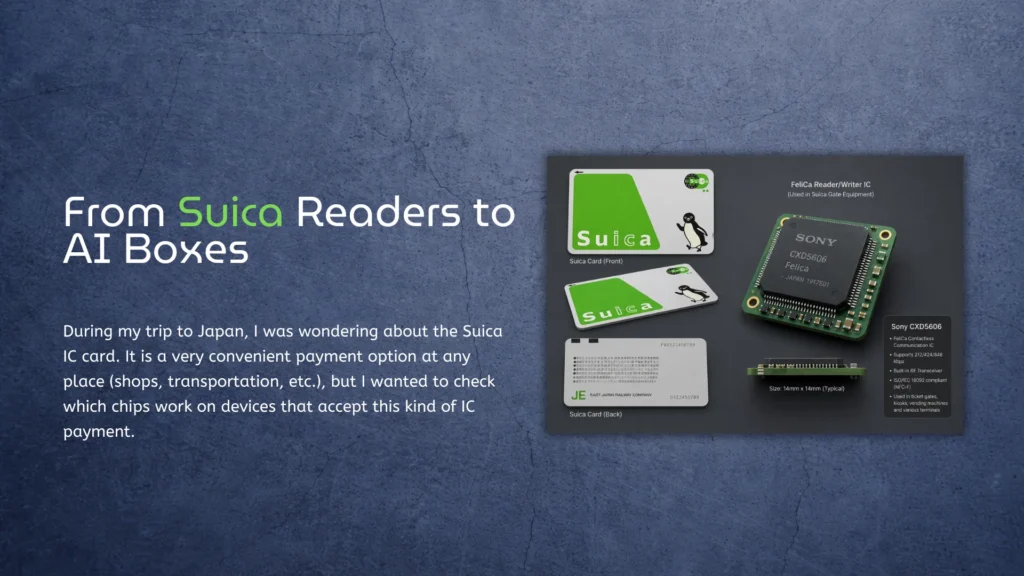
During my trip to Japan, I was wondering about the Suica IC card (FeliCa NFC). It is a very convenient payment option at any place (shops, transportation, etc.), but I wanted to check which chips work on devices that accept this kind of IC payment.
And honestly, if you’ve ever seen Tokyo stations during rush hour, you know these systems can’t afford to be slow even for a second. Thousands of people are constantly moving through the gates. If every person had to wait even half a second longer, the whole station would become a traffic jam immediately.
It’s Not Just NFC
Sony’s FeliCa technology (FeliCa NFC)
Most people think Suica is basically the same thing as regular contactless payment. But Japan’s system is a bit different. Suica uses Sony’s FeliCa technology (FeliCa NFC), and the whole thing was built around one idea: people should not stop walking while paying. That was the goal from the beginning.
And when you think about it, that’s actually pretty crazy.
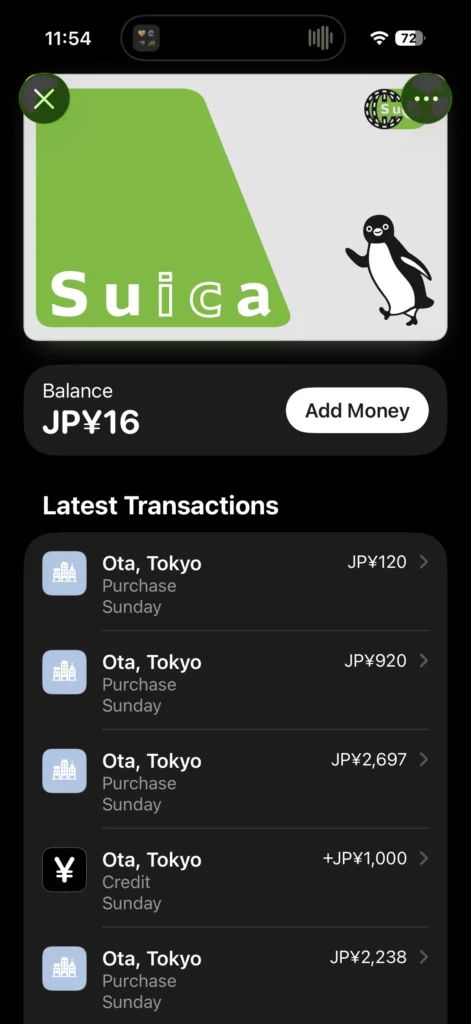
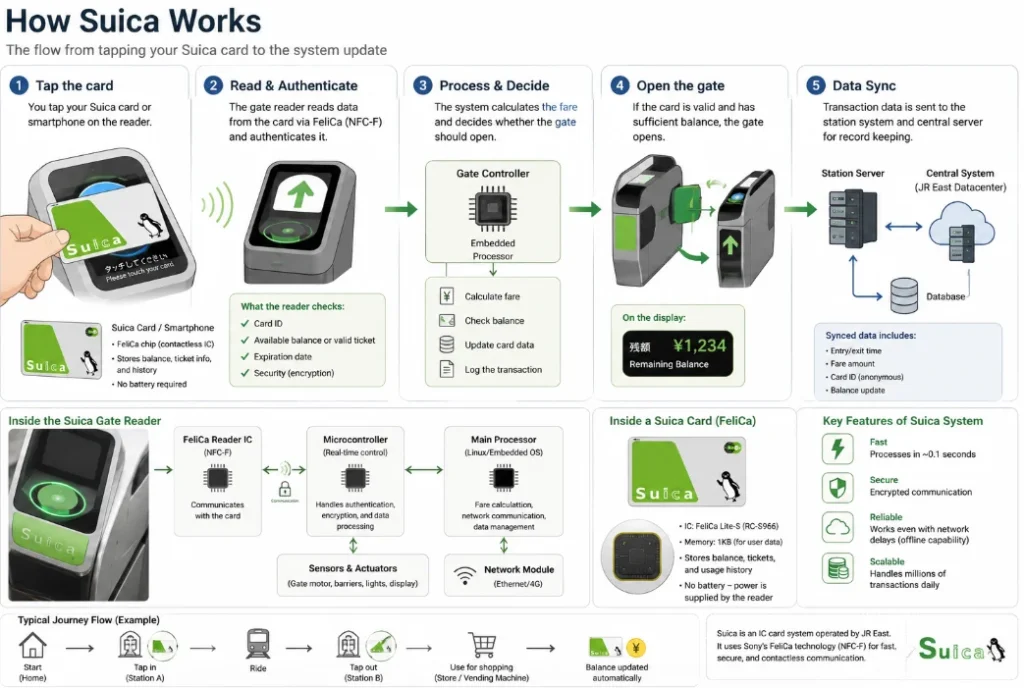
The gate has to communicate with the card or phone, verify everything, calculate the fare, update the balance, open the gate, show confirmation on the display, and sync data with the station network almost instantly. And it all happens so fast most people never even notice.
What’s Probably Inside These Gates?
ARM Hardware
Railway companies almost never show the full specs of their hardware publicly, but the general setup is pretty easy to imagine.
At the bottom level, there are dedicated FeliCa and NFC controller chips handling communication with cards and phones. Then there are embedded microcontrollers managing sensors, timing, transaction validation, and the physical gate itself. Above that, you usually have ARM-based embedded processors running Linux or some specialized real-time OS. Those processors handle networking, displays, diagnostics, logs, and communication with the station infrastructure.
And honestly, ARM makes perfect sense here.
Why ARM Fits So Well
A normal desktop processor would be terrible for something like a train station. Too much heat, too much power usage, more maintenance, more failure points. Transit systems need hardware that can sit there running for years without problems.
That’s why ARM became huge in embedded and industrial systems a long time ago. Low power consumption, stable operation, compact design – exactly what infrastructure needs.
The funny thing is modern ARM chips are way more powerful than people realize. A lot of them now include GPUs, AI accelerators, multimedia engines, security modules, and NPUs directly on the chip. Modern embedded hardware honestly starts looking very close to compact AI systems. You can already see this happening in newer embedded platforms (for example, RK3588-based platforms) built for edge computing and AI workloads that combine strong CPU performance with efficient local processing.
Stations Are Becoming Edge AI Systems
And this is where things get interesting.
Modern stations are doing way more than just checking tickets now. There are cameras everywhere, digital signs, passenger flow monitoring, multilingual systems, diagnostics, analytics, and all kinds of real-time monitoring running constantly.
If all of that depended entirely on cloud servers, latency would become a huge problem. Especially in places like Shinjuku Station or Tokyo Station where the amount of people moving around is just insane.
So more processing is happening locally now instead. Compact edge systems can process camera feeds, manage displays, monitor crowds, and detect problems directly on-site without constantly sending everything to remote servers.
That’s also why small AI-focused edge devices are suddenly becoming useful far beyond simple hobby projects. Transportation systems, smart infrastructure, and industrial automation are all starting to use similar hardware ideas.
And honestly, this is the funny part. Everybody talks about edge AI today like it’s some futuristic new trend. But Japanese transportation (and, of course, Chinese) systems were already using very similar ideas years ago. Local processing. Low latency. Real-time responses. Energy-efficient computing. Reliable embedded systems running 24/7.
The Weird Part
That’s also why hardware like Rockchip Embedded Platform, like RK3588 (or Rockchip RK3576), suddenly makes a lot more sense outside of hobby SBCs and mini PCs anyway.
The requirements are actually very similar. Compact hardware, low power usage, stable long-term operation, local AI processing, real-time workloads. Transportation systems, robotics, smart city infrastructure, industrial automation – all these areas are slowly starting to overlap.
You can already see that overlap happening across modern edge AI and robotics deployments that increasingly rely on localized processing instead of constant cloud communication.
And in the end, that tiny Suica tap is hiding a ridiculous amount of engineering underneath. Embedded systems, ARM architecture, RFID communication, industrial hardware design, real-time computing – decades of optimization packed into one tiny interaction.
Most people just hear the beep and keep walking. But there’s a surprisingly serious amount of hardware working behind that little moment.