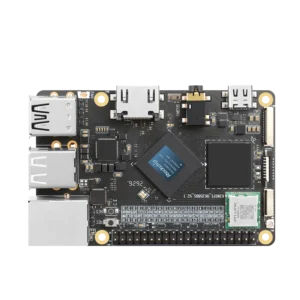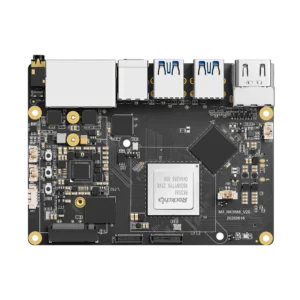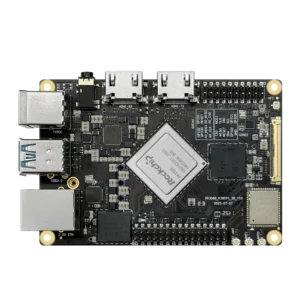


Allwinner H700 ends up in $50 retro handhelds. Rockchip RK3588 ends up on boards with NVMe, multiple camera inputs, dual Ethernet and enough RAM to run local AI models.
Calling Allwinner the cheap option and Rockchip the fast one is easy. It also doesn’t answer the useful question: how much of that extra Rockchip hardware will your device actually use?
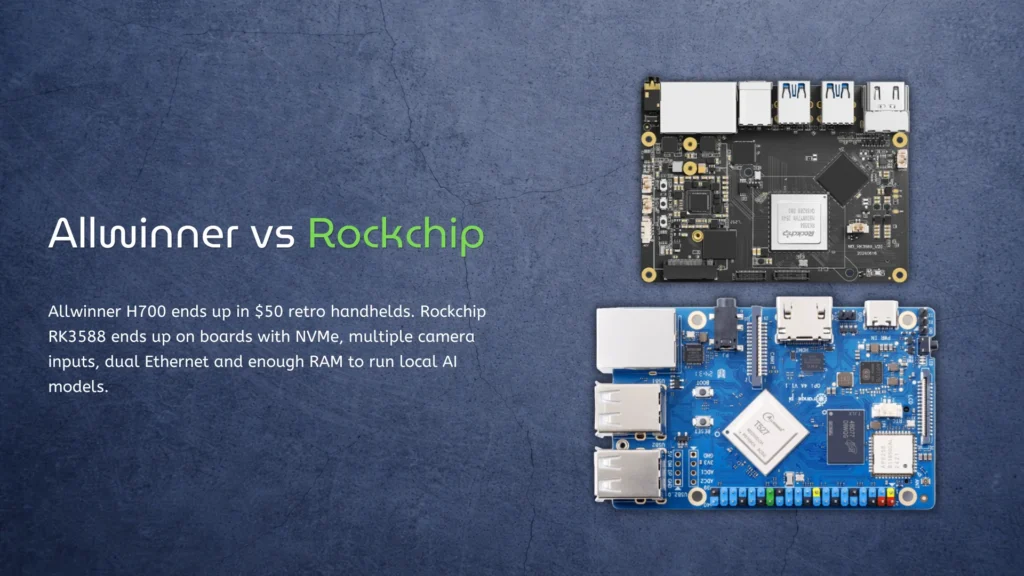
H700 is much slower than RK3588. It is also fast enough for most 8-bit, 16-bit and original PlayStation games. RK3588 can do far more, but buying it to drive one display and launch a few lightweight applications would be a strange use of the money.
That’s the real Allwinner vs Rockchip argument. It isn’t about which company makes the better chip. It is about when good enough stops being good enough.
H700 wins by doing less
Allwinner’s H700 has four Cortex-A53 cores, Mali-G31 graphics and no NPU. None of that sounds exciting. The chip’s more useful feature is its video engine: it supports 10-bit 4K60 decoding, along with HDMI 2.0, LVDS, RGB and CVBS display outputs.
That combination makes sense in a cheap handheld. Older console emulation doesn’t need PCIe, USB 3.0 or an AI accelerator. It needs enough single-threaded CPU performance, working graphics drivers and firmware that doesn’t turn setup into a weekend project.
RK3566 is the obvious Rockchip alternative. Its Cortex-A55 cores are newer, Mali-G52 is faster, and the chip includes a 1 TOPS NPU. It gives Nintendo 64, Dreamcast and PSP emulators more room before individual games fall below full speed. For other embedded applications, Rockchip also offers the Rockchip RK3562, which uses a 1 TOPS NPU and Cortex-A53 cores for tablets and industrial equipment.
But for SNES, Mega Drive, Game Boy Advance and most PlayStation games, that advantage often changes the specification sheet more than the experience. Our article with H700 and RK3566 compared looks at exactly where the faster Rockchip chip starts to matter.
This is why H700 became popular. It isn’t secretly fast. It is cheap, widely used and sufficient for the systems most buyers expect an inexpensive handheld to run. The separate Allwinner H700 performance guide covers those limits without pretending it is a general-purpose performance chip.
Allwinner has moved upmarket
H700 makes Allwinner look further behind than it really is.
T527 uses eight Cortex-A55 cores, Mali-G57 graphics and a 2 TOPS NPU. Radxa’s Cubie A5E pairs it with dual Gigabit Ethernet, NVMe storage, Wi-Fi 6 and Debian support. That is a proper Linux SBC, not a TV-box processor attached to a microSD slot.
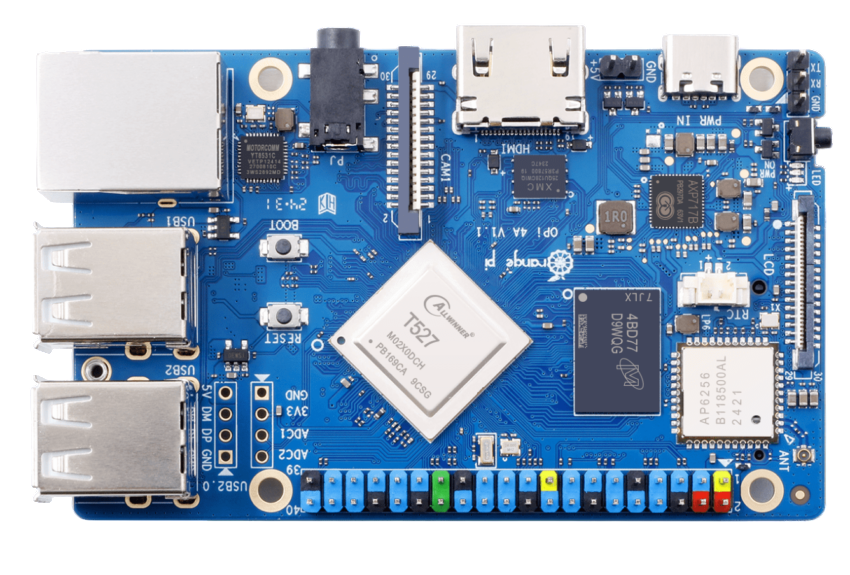
A733 goes further: two Cortex-A76 cores, six Cortex-A55 cores, LPDDR5 and a 3 TOPS NPU. Radxa offers Cubie A7A configurations with up to 16 GB of memory. For a compact Linux computer, HMI or modest edge AI system, current Allwinner hardware is no longer difficult to justify.
The problem is what happens above that level.
| SoC | CPU | GPU | NPU | The practical fit |
| Allwinner H700 | 4× Cortex-A53 | Mali-G31 | None | Cheap handhelds and multimedia |
| Rockchip RK3566 | 4× Cortex-A55 | Mali-G52 | 1 TOPS | Faster handhelds and small SBCs |
| Allwinner T527 | 8× Cortex-A55 | Mali-G57 | 2 TOPS | Gateways, HMI and light edge AI |
| Allwinner A733 | 2× A76 + 6× A55 | BXM-4-64 | 3 TOPS | Mid-range Linux and AI boards |
| Rockchip RK3588 | 4× A76 + 4× A55 | Mali-G610 | 6 TOPS | High-end SBCs, cameras and local AI |
A733 is a large step up from H700, but it still has two Cortex-A76 performance cores rather than four, half the advertised NPU throughput of RK3588, and a less ambitious I/O and multimedia platform.
Allwinner now has credible mid-range SBC processors. It still doesn’t have a direct answer to RK3588.
Rockchip RK3588
RK3588 combines four Cortex-A76 and four Cortex-A55 cores with Mali-G610 graphics, a triple-core 6 TOPS NPU, 8K video processing, PCIe 3.0, SATA, USB 3.1 and multiple camera and display interfaces.
That list is impressive. It is also mostly wasted on a basic media player.
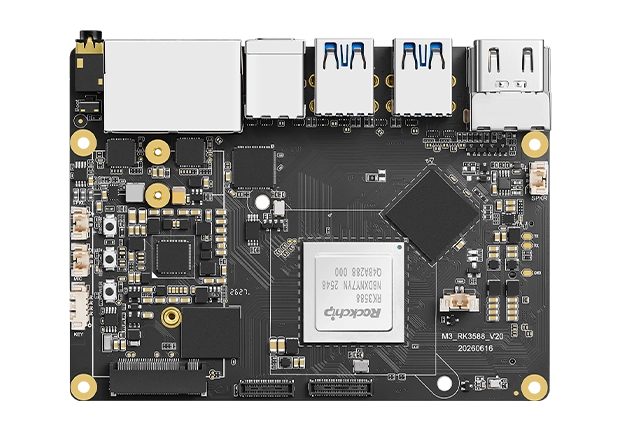
The chip starts to make sense when several jobs happen at once: decode camera streams, prepare frames, run object detection, display a local interface, save events to NVMe and send results over the network. Now the NPU is only one part of the workload. CPU performance, memory bandwidth and I/O stop being optional extras.
This is also why a broad “Allwinner board vs Rockchip board” benchmark can be misleading. One device may be designed to hit a price. The other may be designed to keep adding peripherals until every available lane is occupied. They aren’t solving the same problem.
TOPS
The AI comparison looks simple: no NPU on H700, 1 TOPS on RK3566, 2 TOPS on T527, 3 TOPS on A733 and 6 TOPS on RK3588.
So RK3588 should be twice as fast as A733… except TOPS isn’t a benchmark.
Precision, supported operators, model conversion, memory and preprocessing all affect real inference speed. If one layer falls back to the CPU, the larger number on the product page won’t save the pipeline. Our guide to what TOPS actually measures explains why these figures are useful without treating them as measured performance.
Still, the hardware around the NPU matters. RK3588 is easier to justify for several cameras or a heavier application because its faster CPU and broader I/O can keep the accelerator fed. If a small model already meets its latency target on T527, the same logic works in reverse: 6 TOPS won’t make the finished product twice as useful.
Why KiwiPi uses Rockchip
The KiwiPi 5 Pro board uses RK3588 and exposes the features that make the chip worth buying: up to 32 GB of LPDDR4X, M.2 NVMe, dual 2.5 Gigabit Ethernet, multiple USB 3.0 ports, camera connections and a 6 TOPS NPU.
For a retro console, this would be ridiculous overkill. For robotics, a multi-camera system, a network appliance or local AI development, the same hardware begins to look reasonable.
That’s the dividing line. Allwinner works well when the device has a fixed purpose and price matters more than expansion. Rockchip becomes the safer choice when the board has to behave like a small computer rather than the controller inside one product.
Neither company wins every comparison. But there are two easy ways to waste money: forcing a cheap Allwinner chip to do a job it was never meant for, or buying RK3588 and leaving most of it idle.