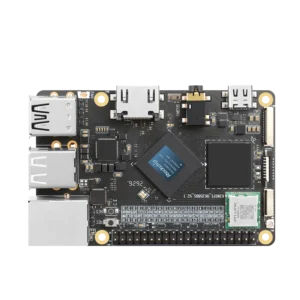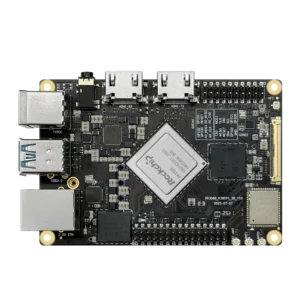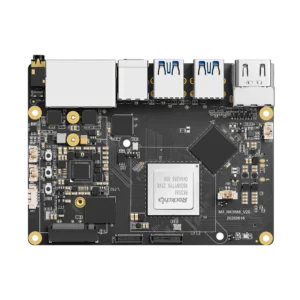


Allwinner H700 is not a new performance champion. It combines four Cortex-A53 CPU cores with a Mali-G31 GPU – hardware that looks modest beside modern mobile and embedded processors. For a broader Allwinner vs Rockchip comparison, see our detailed guide. Yet the chip has become remarkably common in affordable Linux gaming handhelds.
This is not a case of an old processor being secretly fast. H700 succeeds because retro gaming has very different requirements from Android tablets, desktop Linux, or current-generation games. It offers enough CPU performance for older console emulation, a considerably newer GPU than many inexpensive Cortex-A53 platforms, and a capable multimedia subsystem without pushing device prices higher.
That balance matters more than an impressive benchmark result.
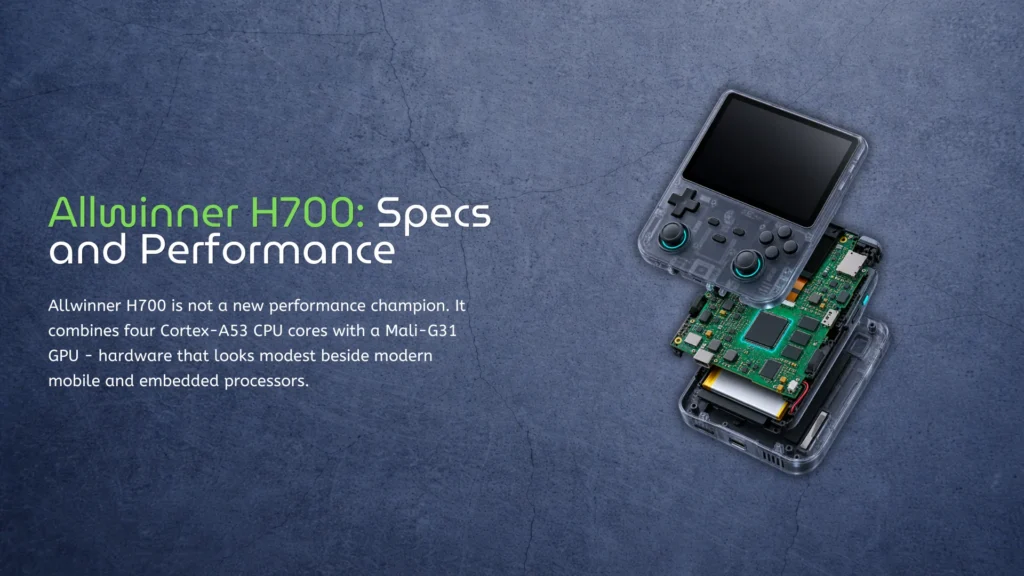
Allwinner H700 specifications
Allwinner originally positioned H700 as a multimedia processor rather than a gaming-specific SoC. Its four 64-bit Cortex-A53 cores are paired with a multicore Mali-G31 GPU based on Arm’s Bifrost architecture.
| Feature | Allwinner H700 |
| CPU | 4× Arm Cortex-A53 |
| CPU architecture | 64-bit Armv8-A |
| Typical handheld clock | Up to approximately 1.5 GHz |
| GPU | Multicore Arm Mali-G31 |
| Graphics APIs | OpenGL ES 3.2 and Vulkan 1.1 |
| Video decoding | Up to 4K at 60 fps, 10-bit |
| Display interfaces | HDMI 2.0, dual-link LVDS, RGB and CVBS |
| Common handheld memory | LPDDR4 |
| NPU | None |
| Typical applications | Retro handhelds and multimedia devices |
The official Allwinner H700 product brief also lists USB 2.0, SDIO 3.0, camera input, Gigabit Ethernet MAC and several display outputs. These features reveal the chip’s original purpose: H700 was designed to decode video and drive displays economically, not to compete with high-performance application processors.
Clock speeds and available interfaces still depend on the finished device. A handheld manufacturer can impose different thermal limits or leave some SoC features unused.
Cortex-A53 is old, but sufficient here
Cortex-A53 is the clearest limitation of H700. It is a compact in-order CPU core designed around efficiency, silicon area and cost rather than strong single-threaded performance.
Heavy web pages, complex Android applications, software compilation and demanding emulators expose that weakness quickly. Adding four cores helps with parallel workloads, but it does not make an individual emulation thread substantially faster. Our explanation of how Cortex-A53 cores perform shows why the architecture remains useful in fixed-function devices but feels slow in interactive general-purpose systems.
Retro gaming is more forgiving. H700 comfortably handles systems such as the NES, SNES, Mega Drive, Game Boy Advance and original PlayStation when the firmware and emulator are properly configured.
Nintendo 64, Dreamcast and PSP sit closer to the limit. Some games run well, while others require frame skipping, reduced resolution or emulator-specific adjustments. A product page claiming “PSP support” therefore does not mean that the entire PSP library will maintain full speed.
H700 is best understood as an excellent 8-bit, 16-bit and PlayStation-class platform – not a universal emulation processor.
Mali-G31 changes the character of the chip
The GPU is what separates H700 from many older budget SoCs. Arm describes the Mali-G31 GPU as a cost-focused Bifrost design supporting OpenGL ES 3.2 and Vulkan.
Mali-G31 is not a powerful modern gaming GPU. Nevertheless, it provides a much newer graphics foundation than the Mali-400 and Mali-450 designs found in numerous low-cost Cortex-A53 processors. That difference matters for emulator rendering, shaders, Linux graphics drivers and Vulkan support.
Consider the older Rockchip RK3328 platform. RK3328 also combines four Cortex-A53 cores with 4K video decoding, but its Mali-450 MP2 GPU belongs to an earlier architectural generation and does not support Vulkan.
RK3328 remains useful for media playback, lightweight network services and simple Linux systems – especially because suitable boards can provide USB 3.0. H700 is a more natural fit for a low-cost gaming handheld, where modern graphics support matters more than fast external storage.
H700 versus Rockchip alternatives
The most relevant Rockchip alternatives do not compete with H700 in exactly the same way.
| SoC | CPU | GPU | Practical advantage |
| Allwinner H700 | 4× Cortex-A53 | Mali-G31 | Low-cost retro handhelds |
| Rockchip RK3328 | 4× Cortex-A53 | Mali-450 MP2 | Media and lightweight servers |
| Rockchip RK3566 | 4× Cortex-A55 | Mali-G52 2EE | Faster handhelds and consumer devices |
| Rockchip RK3568 | 4× Cortex-A55 | Mali-G52 2EE | Embedded I/O and product development |
RK3566 is the most direct performance upgrade. Its Cortex-A55 cores offer better CPU performance, while Mali-G52 provides additional graphics headroom. This makes RK3566 more suitable for demanding emulation and general-purpose devices, although cooling, memory and firmware remain important.
RK3568 belongs to the same general CPU and GPU class as RK3566 but serves a different market. PCIe, SATA, industrial interfaces, networking options and an integrated NPU are more important here than handheld gaming. Our overview of Rockchip RK3568 specifications and uses explains why it is more suitable for industrial computers, storage systems and expandable embedded products.
H700 is cheaper and more narrowly focused. RK3566 offers more performance, while RK3568 provides a much stronger development platform.
More information about RK3566 and Allwinner H700 comparison in another article.
Software determines the real experience
Two H700 handhelds can behave differently despite advertising the same processor. Emulator versions, CPU governors, GPU drivers, frame pacing, memory configuration and power management all affect performance.
This is why custom firmware matters so much in the H700 ecosystem. A well-maintained community distribution can improve menus, sleep behaviour, emulator settings and game compatibility. It cannot turn Cortex-A53 into Cortex-A55, but it can remove enough software friction to make the hardware feel considerably better.
Buyers should therefore evaluate the complete handheld and its firmware community instead of judging the device by the SoC alone.
Is Allwinner H700 still worth choosing?
H700 remains a sensible choice for an inexpensive Linux handheld intended mainly for systems up to the original PlayStation. It combines sufficient CPU performance with modern-enough graphics, capable video hardware and relatively modest power requirements.
It is less convincing for Android, advanced emulation or a new general-purpose embedded product. RK3566 provides more processing headroom, while RK3568 offers better interfaces and expansion.
H700 became successful because it does not attempt to solve every problem. Its old CPU cores, newer budget GPU and multimedia hardware happen to match the needs of affordable retro handhelds unusually well. Within that narrow role, it remains one of the most rational low-cost SoCs available.
FAQ
Is Allwinner H700 good for retro gaming?
Yes. It is particularly well suited to 8-bit, 16-bit and original PlayStation emulation. Nintendo 64, Dreamcast and PSP performance varies between games.
Is H700 faster than Rockchip RK3328?
Their CPU performance is broadly similar, but H700 has a newer Mali-G31 GPU. RK3328 can be more useful for media boxes and lightweight servers, especially on boards with USB 3.0.
Is RK3566 better than H700?
RK3566 is generally faster because it uses Cortex-A55 CPU cores and Mali-G52 graphics. H700 can still make more sense in a cheaper handheld designed primarily for older consoles.
Does Allwinner H700 support Vulkan?
The Mali-G31 GPU supports Vulkan 1.1. Actual availability depends on the operating system and graphics driver used by the device.
Can H700 emulate PSP games?
It can run some PSP games well, but results are inconsistent across the library. More demanding titles may require reduced rendering resolution or frame skipping.