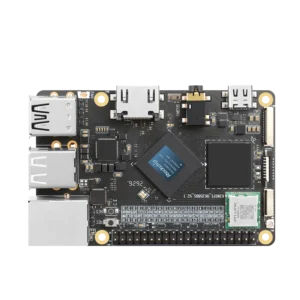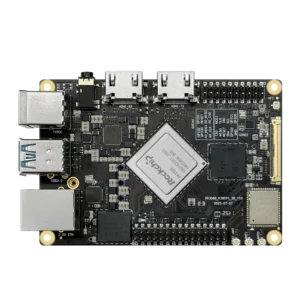


Arm Cortex-A53 has an unusual problem: it was so successful that manufacturers are still using its name to make inexpensive hardware sound current. A specification such as octa-core 64-bit CPU remains persuasive on a product page, even when all eight cores are Cortex-A53 designs from an earlier generation.
This marketing tactic often blurs the line between ARM and x86, a topic we clarify in our ARM vs x86 Architecture explained guide.
That does not make Cortex-A53 a bad CPU. Its small size, low power requirements, 64-bit support, and mature software ecosystem made it one of the most useful Arm cores ever designed. But its strengths are now very specific. Cortex-A53 still works well when a device has a narrow job and dedicated hardware handles the demanding parts; it is much less convincing when the CPU itself must provide a responsive desktop or run modern applications.
Cortex-A53 is a core, not a complete processor
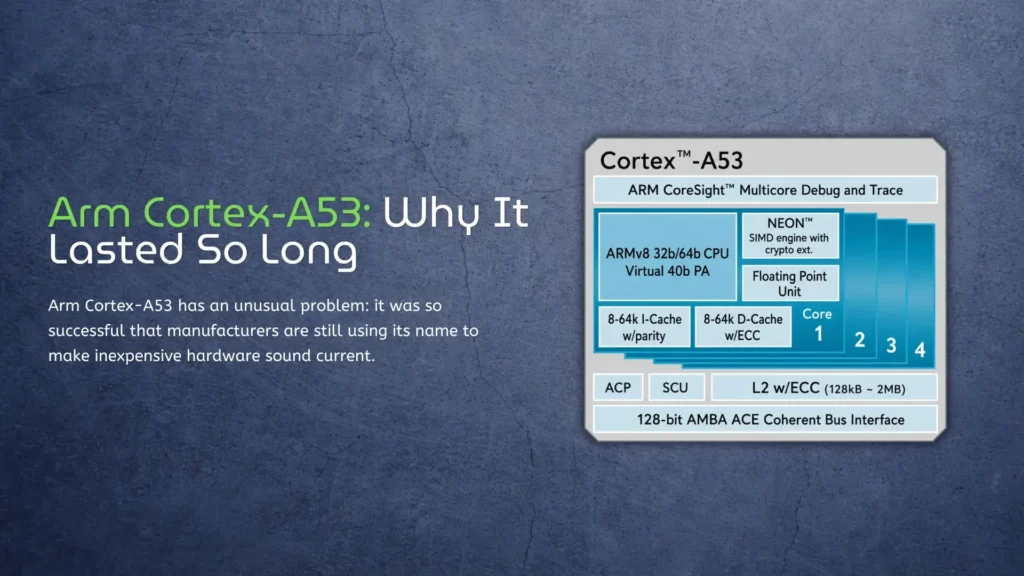
The first source of confusion is the name. Cortex-A53 is CPU intellectual property licensed by Arm, not a finished system-on-chip. A chip designer combines it with memory controllers, a GPU, media engines, networking, and other components, then chooses the clock speed and manufacturing process.
This is why two Cortex-A53 devices can behave nothing alike. Core count, memory, cooling, and the media engine all vary. Features such as 4K video, HDR, USB 3.0, and an NPU come from the surrounding SoC, not from Cortex-A53.
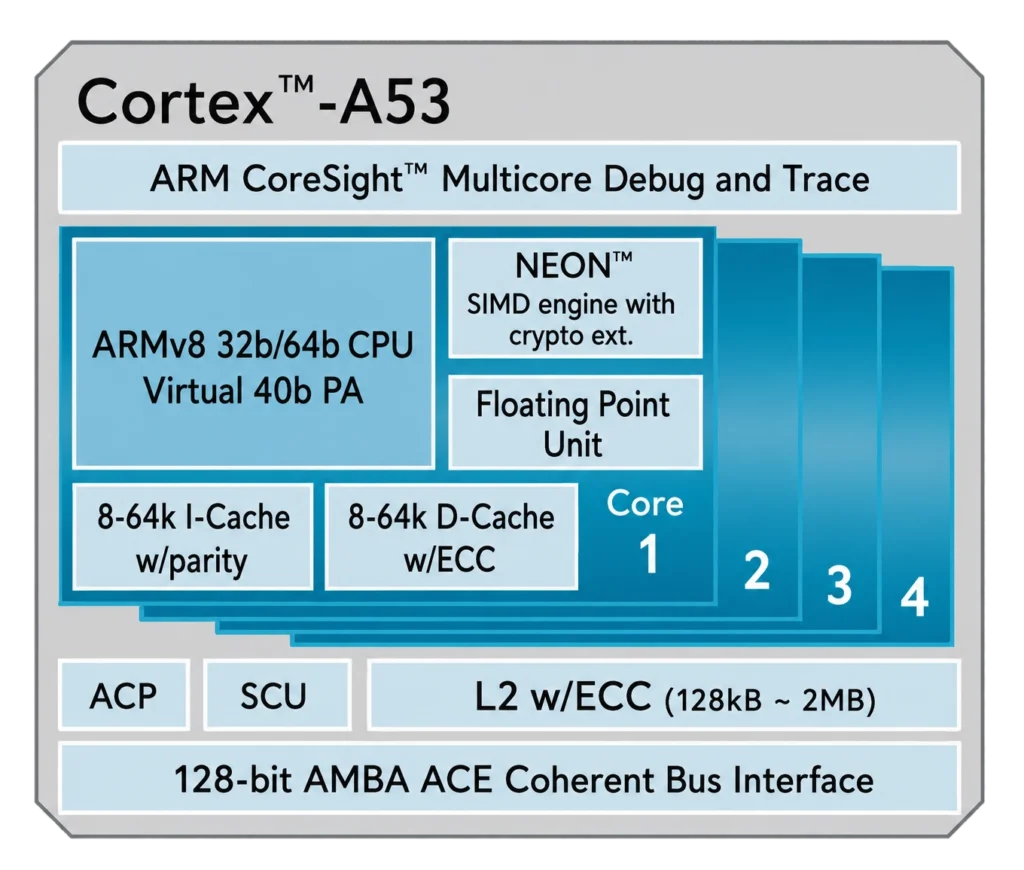
According to the official Arm Cortex-A53 specifications, one cluster contains up to four cores with private L1 caches and a shared L2 cache. The Armv8-A design runs both 64-bit AArch64 and 32-bit AArch32 software and supports Neon, TrustZone, virtualization, and big.LITTLE configurations.
Its simplicity was the feature
Cortex-A53 uses an in-order design, with less freedom to rearrange instructions than a large out-of-order core. This hurts performance when the CPU encounters a cache miss or unpredictable branch, but it also reduces silicon area, power consumption, and cost.
For the products that made Cortex-A53 popular, this was a good bargain. A TV box can offload video to a dedicated decoder, while a router or industrial gateway often runs a fixed set of services below full load. Manufacturers received a compact 64-bit CPU with broad Linux and Android support without the cost of a high-performance core.
The problem appears when the workload becomes interactive. Web pages, compilation, and many emulators depend heavily on single-thread performance. More Cortex-A53 cores can improve parallel throughput, but they do not make one browser or game thread twice as fast.
The SoC often matters more than the CPU
Rockchip RK3328 shows why Cortex-A53 hardware should be judged as a complete platform. Its four CPU cores are modest, but hardware video decoding, USB 3.0, and Gigabit Ethernet support keep it useful. Our overview of Rockchip RK3328 specifications and uses explains why it can still work in media players and lightweight servers.
The Rockchip RK3528 media processor makes the same point: its Cortex-A53 cores are modest, but the dedicated video hardware can decode 4K video at 60 fps.
Those media capabilities do not make the CPU faster. If software decoding is required, Cortex-A53 quickly becomes the bottleneck. Memory bandwidth, drivers, board design, and cooling likewise determine whether the device can use its advertised interfaces effectively.
This explains the inconsistent reputation of Cortex-A53 hardware. A supported SBC with mature Linux can be dependable, while a TV box with outdated firmware and poor cooling may be frustrating despite using the same cores.
Cortex-A53 versus Cortex-A55 and Cortex-A76
| Feature | Cortex-A53 | Cortex-A55 | Cortex-A76 |
| CPU role | Low-cost efficiency core | Newer efficiency core | High-performance core |
| Architecture | Armv8-A | Armv8.2-A | Armv8.2-A |
| Execution | In-order | In-order | Out-of-order |
| Main advantage | Small, efficient, mature | Better efficiency-core performance | Much stronger single-thread performance |
| Typical use | Routers, media devices, basic SBCs | Newer embedded and mobile SoCs | Desktops, premium mobile, faster SBCs |
Cortex-A55 is the direct replacement. It preserves the efficiency-focused role while improving branch prediction, the memory system, and performance. For a new low-cost SoC, it provides more useful headroom without requiring a large core.
Cortex-A76 answers a different question. Its out-of-order design trades more power and silicon area for responsiveness and per-core speed. As our Cortex-A76 architecture and performance analysis shows, it belongs to a much higher performance class.
Clock speed and core count do not describe how much work each core completes. Four Cortex-A76 cores can deliver a much better desktop experience than eight Cortex-A53 cores, even if the latter looks more impressive in a marketplace listing.
Where Cortex-A53 still makes sense
There is no reason to retire Cortex-A53 hardware that already performs a defined task reliably. It remains suitable for DNS filtering, home automation, simple Linux services, routers, and hardware-accelerated media playback. Here, software support and low power consumption can matter more than benchmarks.
For a new general-purpose SBC, the value proposition is weaker. Cortex-A53 offers little reserve for web applications, compilation, emulation, or local AI; any advertised NPU is a separate SoC block. A newer efficiency core usually offers a longer useful life.
FAQ
Is Arm Cortex-A53 a 64-bit CPU?
Yes. Cortex-A53 implements Armv8-A and supports both 64-bit AArch64 and 32-bit AArch32 execution. The device still needs suitable firmware and a 64-bit operating system to use AArch64 software.
Does Cortex-A53 support 4K video?
Not by itself. Dedicated video and display blocks elsewhere in the SoC determine codec, resolution, HDR, and display support.
Is Cortex-A53 still good for Linux?
Yes, for lightweight servers and embedded workloads. Board support, drivers, memory, storage, and cooling matter as much as the CPU core, while a modern desktop can feel slow.
The longevity is real, but so are the limits
Cortex-A53 lasted because it was inexpensive, efficient, flexible, and good enough for products where the CPU was only one part of the solution. That remains a useful formula for fixed embedded workloads. But in a new general-purpose device, 64-bit octa-core should not distract from the real issue: Cortex-A53 no longer provides modern per-core performance.