





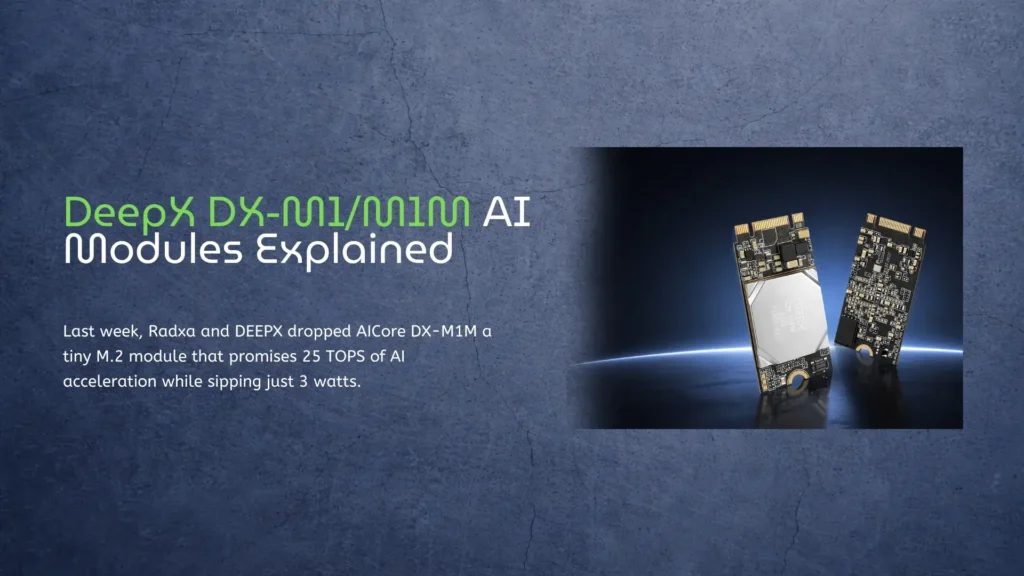
Last week, Radxa and DEEPX dropped AICore DX-M1M a tiny M.2 module that promises 25 TOPS of AI acceleration while sipping just 3 watts.
Remember the AI accelerators that turned out to be glorified USB sticks with half-baked drivers? Yeah.
But this thing? It fits in your M.2 slot, like an NVMe drive. And it claims to run YOLO, ResNet, pose estimation – the whole nine yards, without melting your motherboard.
Wait, What Actually Is This Thing?
DeepX is a South Korean AI chip startup, Radxa – the folks behind the ROCK series SBCs – is partnering with them to put this NPU into an M.2 package.
The original AICore DX-M1 AI Module launched in late 2025. That was a bigger M.2 2280 card with PCIe Gen3 ×4, 4GB of LPDDR5, and a 3-5W power envelope. Respectable, but bulky.
The new DX-M1M AI Module is different: smaller, leaner. Meaner in some ways, weaker in others.
| Feature | DeepX DX-M1 (original) | DeepX DX-M1M (new) |
| AI Performance | Up to 25 TOPS | Up to 25 TOPS |
| Form Factor | M.2 2280 | M.2 2242 (M + B Key) |
| Interface | PCIe Gen3 ×4 | PCIe Gen3 ×2 |
| Memory | 4GB LPDDR5 | 1GB LPDDR4X (4266 MT/s) |
| Storage | ? | 1Gbit QSPI flash |
| Power Consumption | 3-5W | ~3W typical |
| Target Use | High-throughput inference | Edge vision, compact systems |
| Price | ? | $85 (but out of stock) |
What jumps out: 25 TOPS at 3 watts is actually impressive. For comparison, the Rockchip’s RK3588 SBCs does 6 TOPS at around 4-5W. The NVIDIA Jetson Orin Nano does 20 TOPS at 7-15W. DeepX is claiming better efficiency than both. That’s a bold flex.

The M.2 Magic (And The Compromises)
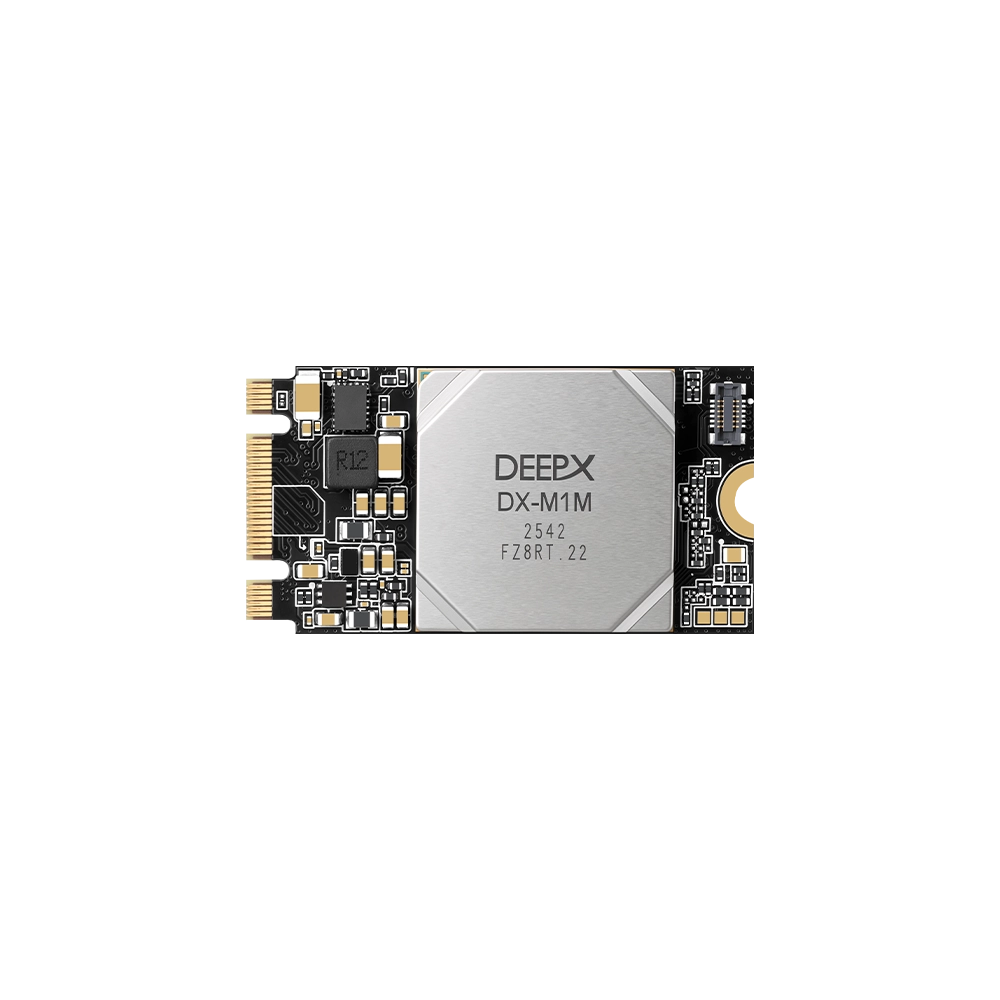
The DX-M1M uses an M.2 2242 M + B Key form factor. That’s shorter than a standard 2280 SSD 42mm instead of 80mm. It fits in more places, including the cramped internals of a Raspberry Pi 5 or Radxa ROCK 5B.
But here’s the trade-off: PCIe Gen3 ×2, not ×4. And only 1GB of LPDDR4X RAM. One gigabyte. That’s… not a lot.
For comparison, the RK3588 can address up to 32GB of system RAM. The DX-M1M has to fit its entire model into that 1GB. Small models only, folks. You’re not running Llama 3 on this thing.
Radxa says it’s designed for image classification, object detection, segmentation, and pose estimation. Translation: YOLOv8 Nano/Tiny, MobileNet, maybe a small ResNet. Not GPT-4.
If you’re building an automotive AI box for your car for driver monitoring or traffic camera analytics, 1GB might actually be fine. Those models are lean. But if you were hoping to run a multi-modal LLM at the edge, keep dreaming.
Host Compatibility – Pi 5, Radxa, And Beyond
Here’s where things get interesting. The DX-M1M supports both ARM and x86 host platforms over PCIe.
Radxa specifically calls out:
- Raspberry Pi 5 (yes, the PCIe FPC connector)
- ROCK 5A / 5B / 5B+ / 5 ITX
- Any M.2 2280 slot via adapter
That means you can slap this NPU onto a Pi 5 and suddenly your $80 SBC has 25 TOPS of AI juice. Eben Upton said in their recent AMA that they see the CPU as a venue for AI compute and won’t add an NPU to the Pi 6. Fine. We’ll just add our own in the M.2 slot, which is exactly the kind of split you see in CPU vs NPU in Edge AI.
The module connects like an NVMe drive insert at an angle, screw it down, boot up. Radxa warns that it generates heat under sustained workloads and recommends active cooling or a metal enclosure. No surprise there. 3W in a 22×42mm package is toasty.
Software – The Usual Nightmare (But Maybe Better?)
DeepX provides the DXNN SDK with:
- DX-COM compiler (supports TensorFlow, ONNX, Keras, PyTorch)
- DX-RT runtime
- Device drivers
- GStreamer plugin for video pipelines
- DX-All Suite for installation
Supported host OSes: Windows 10/11, Ubuntu 20.04/22.04/24.04. Docker deployment is also available.
That’s… actually a reasonable software stack. Better than most Chinese NPU vendors who give you a ZIP file from Baidu Pan and wish you luck.
But let’s be real the proof is in the pudding. I’ve seen full PyTorch support before. It usually means our compiler can convert a ResNet-50 if you use exactly these ops and none of those ops.
If you’re serious about edge AI, you should check out the top 5 AI box 2026 solutions to see how the software experience compares. Rockchip’s RKNN took years to become usable. DeepX is starting from scratch.
The Price Problem
The AICore DX-M1M is listed for $85 on Arace Tech, that’s not cheap.
It’s out of stock at the time of writing, which means either demand is high or supply is nonexistent. Usually the latter for new hardware.
The DX-M1M is strictly an accelerator. It needs a host. So your total system cost is host board. If you’re building a product, you need to run the numbers. Is 25 TOPS worth the extra BOM cost and software integration headache? For some applications, yes. For most? Probably not. The RK3588 specs and performance guide shows that 6 TOPS is enough for a huge range of edge AI tasks. 25 TOPS is overkill for a security camera. It’s not overkill for a warehouse robot with 12 cameras.