

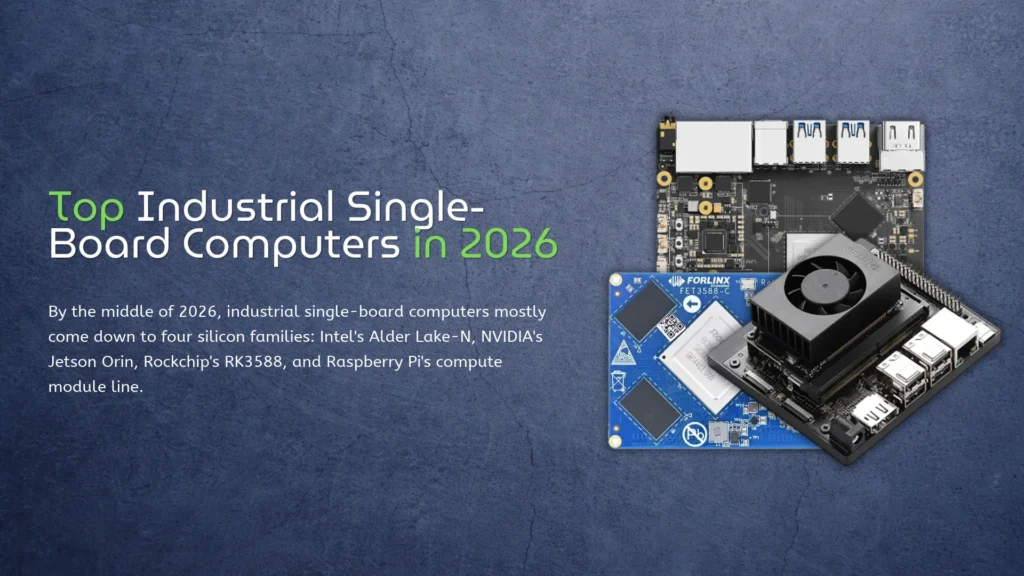
By the middle of 2026, industrial single-board computers mostly come down to four silicon families: Intel’s Alder Lake-N, NVIDIA’s Jetson Orin, Rockchip’s RK3588, and Raspberry Pi’s compute module line. The boards around that silicon differ in ways a CPU table can’t show.
Full transparency, because it changes how you read the rest: I work at KiwiPi, and our KiwiPi 5 Pro shows up below. Everything here is written from datasheets and vendor documentation. I haven’t benchmarked a single one of these boards, including our own.
Temperature, Longevity, and Software
A consumer board is happy in a room.
Put that same board in a machine cabinet, an outdoor box, or an unheated depot, and the spec sheet starts telling the truth. Operating temperature, how many years the vendor keeps selling the same board, and whether the Linux image still receives fixes are what separate industrial hardware from desk toys. CPU speed has very little to do with it, whatever the marketing says.
Software decides more of these purchases than the silicon does. x86 runs Windows and dependable, boring Ubuntu; a Jetson module means CUDA and TensorRT; a Rockchip NPU means the RKNN runtime and a vendor image that actually exposes the GPU, codecs, and camera interfaces. Core counts are easy to market. Images are not. If you are still weighing the two processor families, our ARM vs x86 architecture guide explains the real differences beyond the marketing.
AAEON UP 7000
The Windows crowd doesn’t really have a choice, and AAEON’s UP 7000 is the cleanest way to satisfy it: a fanless x86 board with Intel N50, N97, or N100 from the Alder Lake-N generation. Old binaries, hypervisors, weird enterprise VPN clients – they all just run, which nothing ARM-based here can claim. AAEON sells it as an industrial single-board computer, not a maker toy. The catch is appetite. x86 in this class draws more than the ARM options, there’s no NPU, and if your idea of an industrial job is running camera models at the edge, this board will make you work for it.
NVIDIA Jetson Orin NX 16GB
The AI requests land somewhere else entirely, and they all end at NVIDIA. The Orin NX 16GB module pairs eight Cortex-A78AE cores with 1,024 CUDA cores and 16 GB of LPDDR5, and NVIDIA quotes up to 100 TOPS in Super mode.
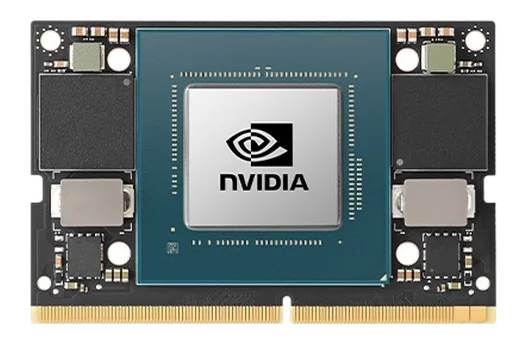
Pause on that number before it does its job on you. It assumes sparse INT8, and it is not the same measurement as the 6 TOPS Rockchip prints for its NPU. Vendors quote whichever figure flatters them; we wrote about what TOPS means for edge AI separately, because that number deserves more suspicion than it gets. You also pay module-plus-carrier prices, and the memory is fixed at 16 GB, which becomes the real limit well before the GPU does. None of that stops most industrial AI boxes from being this module inside a fanless enclosure – the ecosystem is the product, and it is a good one.
Rockchip RK3588J Boards
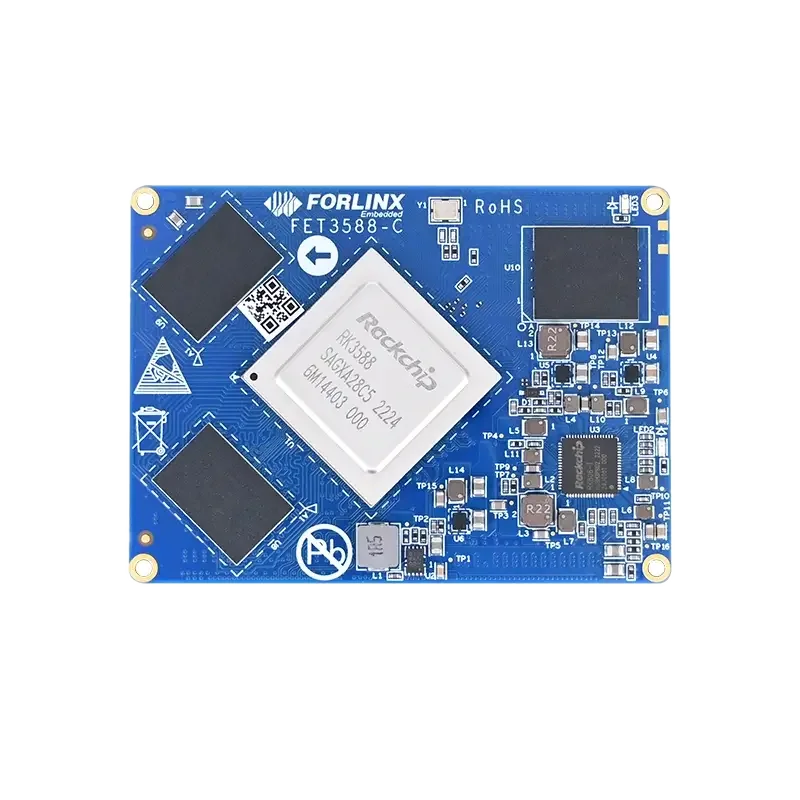
Staying on Rockchip changes the picture, because there is an industrial-grade version of the RK3588 – the chip our own board runs – and it is called RK3588J. Forlinx and other embedded vendors build SOMs and carrier boards around it, sold with wide-temperature and wide-voltage ratings the consumer parts don’t carry. That rating costs you the ecosystem: you live inside the vendor’s SDK, you verify images yourself, and community tutorials won’t save you.
Kunbus RevPi Connect 4
If the deployment is a control cabinet full of existing automation gear, the DIN-rail world pulls hard, and Kunbus’s RevPi Connect 4 is the Raspberry Pi’s entrance into it. It wraps the Compute Module 4 into a DIN-rail computer, with I/O modules, gateways, and fieldbus interfaces mounting on the same rail. The CM4 silicon is old news next to an RK3588, and the pricing is industrial in every sense of the word. That is beside the point: a plant electrician can swap one without reading a manual, and in that world that beats a faster CPU.
KiwiPi 5 Pro
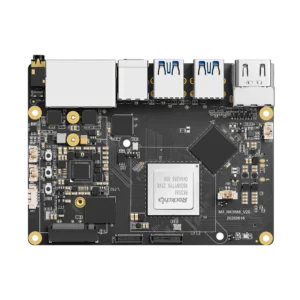
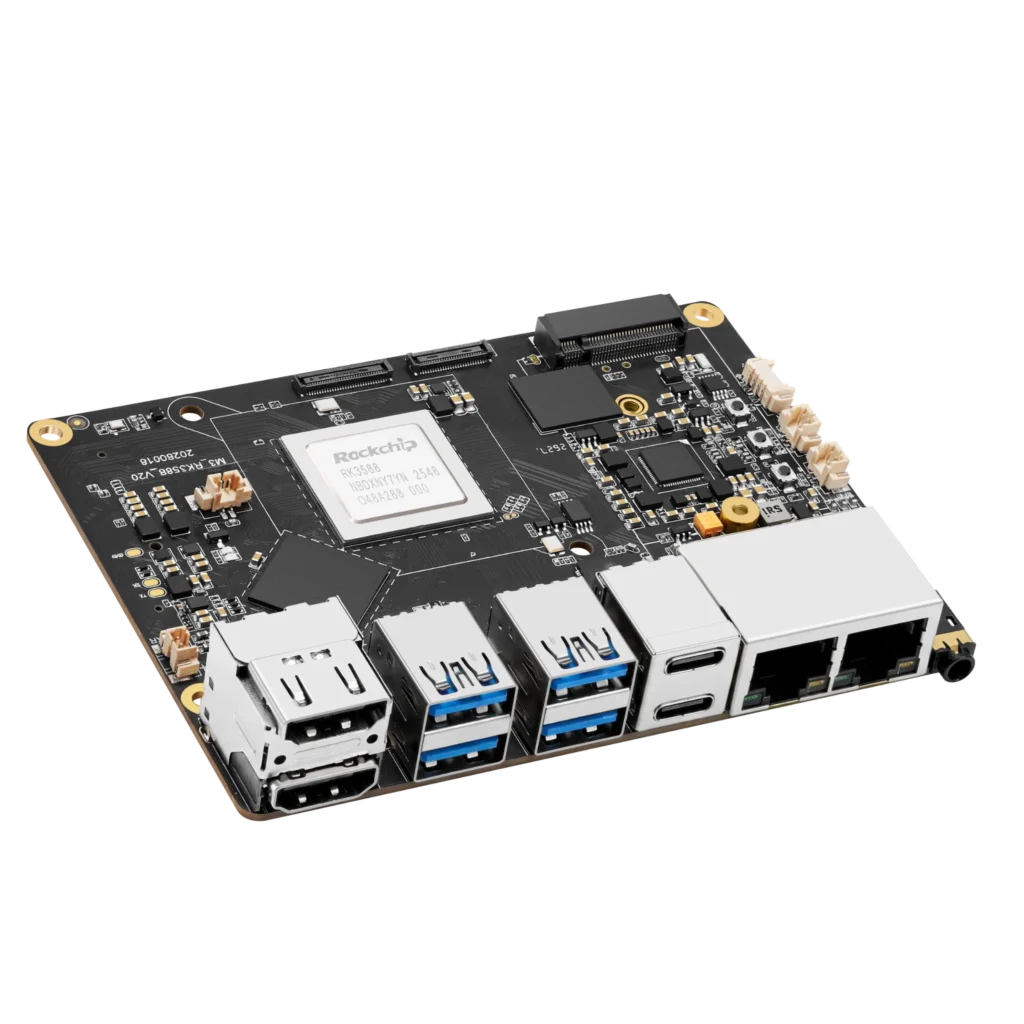
Which leaves the job none of the above cover: a Linux edge gateway with serious networking, and that is our board. KiwiPi 5 Pro runs the RK3588 – four Cortex-A76 cores at 2.2 GHz, four Cortex-A55 at 1.8 GHz, Mali-G610 MC4, a 6 TOPS NPU – and the board itself adds up to 32 GB of LPDDR4X, eMMC up to 512 GB, an M.2 slot for NVMe over PCIe 3.0, two 2.5 GbE ports, Wi-Fi 6, and a second M.2 socket for 4G or 5G modems. Ubuntu 22.04, Debian 11, and Android 15 are the images we ship.
The longer walkthrough lives in our RK3588 specs and performance guide, for anyone who wants the datasheet story without the datasheet.
Honest part: it is not a wide-temperature board and it will not clip onto a DIN rail. If the spec demands extended temperatures or DIN-rail mounting, take an RK3588J board or a RevPi instead. Ours is for gateways, NVRs, and HMIs in rooms with a controlled climate – and even there, check the image against your peripherals before you lock the design.
Picking One
Read it backwards from your constraint, not from the boards: x86 software means the UP 7000, CUDA means the Jetson, DIN-rail mounting means the RevPi, a harsh temperature spec on Rockchip silicon means an RK3588J board, and the gateway job with two 2.5 GbE ports, an NVMe drive, and an NPU is what our KiwiPi 5 Pro does. Bias fully admitted.
Whatever you pick, make availability part of the decision. The fastest board in the world is useless the day the vendor stops selling it and the image stops being maintained; the boring board you can still buy in three years is the industrial one.
Quick Comparison
| Board | Silicon | AI path | Best fit |
|---|---|---|---|
| AAEON UP 7000 | Intel N50 / N97 / N100 (Alder Lake-N) | CPU or separate accelerator | Windows, x86 software, virtual machines |
| NVIDIA Jetson Orin NX 16GB | 8-core Cortex-A78AE, 1,024 CUDA cores | up to 100 TOPS, CUDA and TensorRT | machine vision and AI edge boxes |
| Rockchip RK3588J boards (Forlinx and others) | Rockchip RK3588J | RKNN runtime | wide-temperature Rockchip projects |
| Kunbus RevPi Connect 4 | Raspberry Pi CM4 | CPU only | DIN-rail control and data acquisition |
| KiwiPi 5 Pro | Rockchip RK3588 | 6 TOPS NPU, RKNN | Linux gateways, NVR, edge AI, OEM |
Frequently Asked Questions
What is an industrial single-board computer?
A board sold for continuous service inside machines, cabinets, or outdoor sites. Temperature rating, years of availability, and maintained images matter more than peak CPU performance.
Is x86 or ARM better for industrial boards?
Depends on the software. x86 runs Windows and legacy binaries without translation; ARM boards draw less and often integrate an NPU. Most projects are decided by which image the team can actually support.
Which industrial SBC is best for AI?
If the models are CUDA-based, Jetson Orin NX. On Rockchip, the RK3588 and RK3588J run smaller vision models through RKNN at 6 TOPS. x86 boards have no NPU at all.
Is KiwiPi 5 Pro an industrial board?
It is an open RK3588 board for gateways, NVRs, and OEM systems in controlled environments. It is not a wide-temperature or DIN-rail product, so those requirements point to the RK3588J boards or a RevPi instead.